Cross-border clashes erupt between Pakistani and Afghan forces

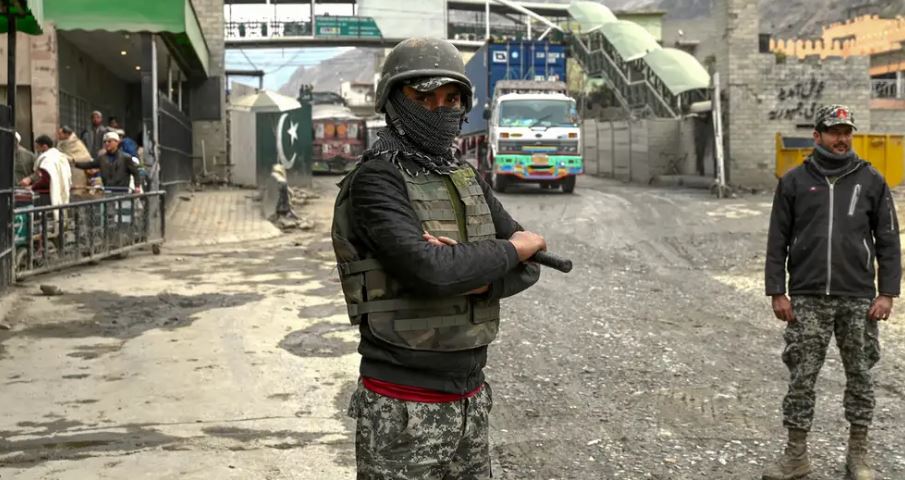
Intense clashes broke out along the Pakistan-Afghanistan border late Saturday night, following a reported Pakistani airstrike in Kabul earlier last week. Reuters reported on October 11 that both sides exchanged heavy fire across multiple locations, with each accusing the other of initiating the conflict. Pakistani security officials claimed that Afghan Taliban fighters launched an unprovoked […]

Asia-Plus

Intense clashes broke out along the Pakistan-Afghanistan border late Saturday night, following a reported Pakistani airstrike in Kabul earlier last week.

Reuters reported on October 11 that both sides exchanged heavy fire across multiple locations, with each accusing the other of initiating the conflict.

Pakistani security officials claimed that Afghan Taliban fighters launched an unprovoked attack on their border posts, prompting Pakistani forces to respond “with full force.”  They reported firefights at more than six locations along the 2,600-kilometer border.

In contrast, Taliban officials said their forces had seized three Pakistani border posts in retaliation for what they described as a violation of Afghan airspace. Pakistani officials countered by saying their military had destroyed several Afghan positions.


Taliban claims retaliation for airspace violation

According to Reuters, Enayatullah Khowarazmi, spokesperson for Afghanistan’s Ministry of Defense, said the attack was in direct response to a recent Pakistani airstrike targeting Kabul. He stated the Taliban operation concluded at midnight local time and warned that Afghan forces are ready to respond again if their airspace is breached.

There was no immediate response from Pakistan on whether the clashes had ended. The border runs for 2,600 kilometers, Reuters noted. 


Underlying tensions and regional rivalries

Tensions along the border have been simmering for months, with Islamabad accusing the Afghan Taliban of sheltering militants from the Tehrik-i-Taliban Pakistan (TTP), who are allegedly supported by India—an accusation New Delhi firmly denies.  The Taliban maintain they do not allow Afghan territory to be used against any other nation.

The latest violence comes amid a broader diplomatic shift.  Last week, the Taliban’s foreign minister visited India—the first high-level visit since the group regained control in 2021—raising alarm in Islamabad over deepening ties between New Delhi and Kabul.

The Pakistani airstrike that allegedly triggered the latest violence reportedly targeted a senior TTP leader traveling in a vehicle in Kabul, according to Pakistani security sources quoted by Reuters.


Join us on social media!

Article translations:

Related Article

Оби зулол
Оби зулол

Most Read

Recent Articles

India’s blockchain push and lessons for the global south

The Indian Government has started pushing aggressively its agenda of embracing blockchain technology, and the same has received a new lease of life with...

India’s blockchain push and lessons for the global south

The Indian Government has started pushing aggressively its agenda...

25 Years in Touch: On Generation Change, “Digital” and “Invisible” Work

In its 25th anniversary year, "MegaFon Tajikistan" summarizes its...

The number of entrepreneurs in Tajikistan increases by 4.3%

The number of entrepreneurs operating under a patent is increasing the fastest.

Trump announces “very good” talks with Iran and the possibility of a quick agreement. Tehran did not comment on this

The President of the United States claims that Tehran has agreed to the US demand to abandon the development of nuclear weapons.

Police report the discovery of the remains of a man who had been missing since December 2025

A friend of the murdered person has been detained on suspicion of particularly brutal murder.

Residents of a settlement in Sughd: “Afghan refugees have disappeared from the Dehmoy jamoat”

Earlier, a citizen of Afghanistan was detained on charges of murdering a resident of Khujand.

In Russia, it was proposed to revoke residence permits and temporary residence permits from migrants who do not work for more than two months

During January-March 2026, 90% more residence permits were revoked from migrants in the country compared to the same period last year.

From reach to influence: why advertising no longer works by old rules discussed in Dushanbe

Market research forces a complete reconsideration of the advertising budget allocation strategy.