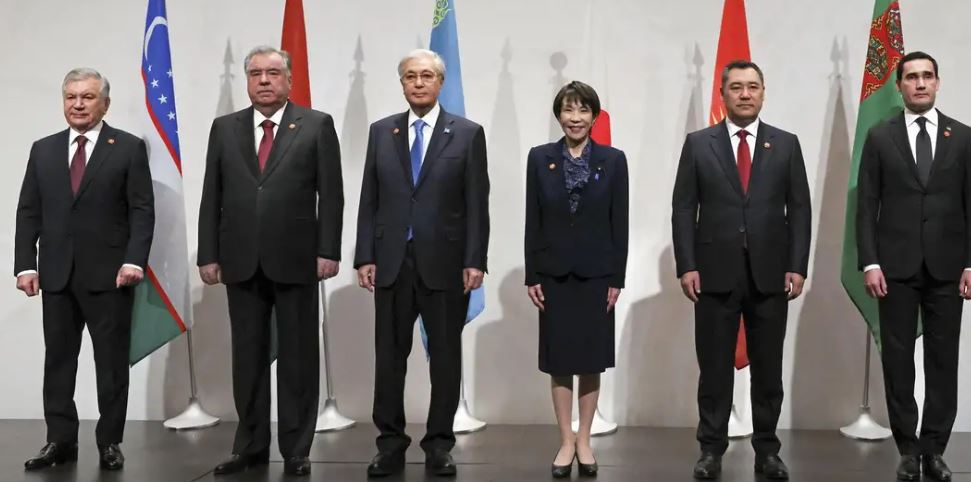
The first-ever “Central Asia–Japan” summit at the level of heads of state and government has concluded in the Japanese capital. The meeting resulted in the signing of the Tokyo Declaration, outlining three priority areas of cooperation: environmental sustainability, communication development, and human capital. Japan also announced plans to implement business projects in the region worth approximately $20 billion over the next five years.
An article by Yekaterian Khvan says experts note that Japan has been pursuing a “soft power” strategy in Central Asia for over three decades. However, the launch of a summit at the highest level signals a strategic shift — Tokyo is looking to strengthen its influence in the region and transition to a more comprehensive partnership.
From soft power to strategic dialogue
According to Professor Timour Dadabayev of the University of Tsukuba, Japan was one of the pioneers in establishing diplomatic ties with Central Asia, launching the cooperation format back in 2004. The recent summit elevates this format to the level of national leaders, turning it from a stable but quiet diplomatic mechanism into a fully-fledged strategic framework. For Central Asia, this opens new diplomatic opportunities; for Japan, it offers a long-term foothold through supply chains, energy transition, critical resources, and investment in human capital.
Mars Sariyev, a regional security expert from Kyrgyzstan, highlights that Japan’s humanitarian engagement has been well received. Japanese volunteers quickly adapt to local cultures, even learning the Kyrgyz language and customs, which helps build strong public trust and positive sentiment toward Japan.
Geopolitics and resource interests
Tajik analyst Sobir Kurbanov believes Japan's growing involvement is largely driven by shifting geopolitical dynamics, including the war in Ukraine. He notes that Japan is particularly interested in rare earth resources and the transit potential of the region. With existing diplomatic frameworks already in place, Tokyo is now moving toward more practical, on-the-ground cooperation.
Similar moves are being made by other players, including the European Union, which recently hosted a summit in Samarkand, and the United States, which has reaffirmed its interest in “Central Asia + One” formats.
Japan’s advantage: quality over quantity
Competing with major powers such as Russia, China, the EU, and the U.S. is no easy task. Yet, as Professor Dadabayev points out, Japan’s involvement adds diplomatic leverage to the region rather than displacing other players. Tokyo also cooperates closely with the EU, allowing for complementary projects, especially in sustainable infrastructure, green energy, and governance standards.
According to Kurbanov, Japan does not aim to outspend its rivals but instead focuses on investment quality — corporate governance, compliance, business ethics, transparency, and adherence to environmental and social norms. This contrasts with some Chinese projects, which have drawn criticism in Kazakhstan, Kyrgyzstan, and to a lesser extent, Tajikistan.
Japan as an investment broker
Central Asia, Kurbanov says, must prioritize internal integration — creating a unified market, open borders, free economic zones, and logistics hubs. The region remains fragmented: some countries belong to the Eurasian Economic Union, others to the WTO, and Turkmenistan remains largely neutral and isolated.
“The stronger the regional integration, the greater the opportunities for attracting external investment, including from Tokyo,” he explains.
Beyond being an investor, Japan could become a strategic broker linking Central Asia with Southeast Asia — a region with limited direct ties but enormous economic potential. Kurbanov believes Tokyo is well-positioned to act as both political and investment intermediary, helping channel funds and build trust between the two regions. For now, however, the summit remains focused on a bilateral “Central Asia–Japan” format.