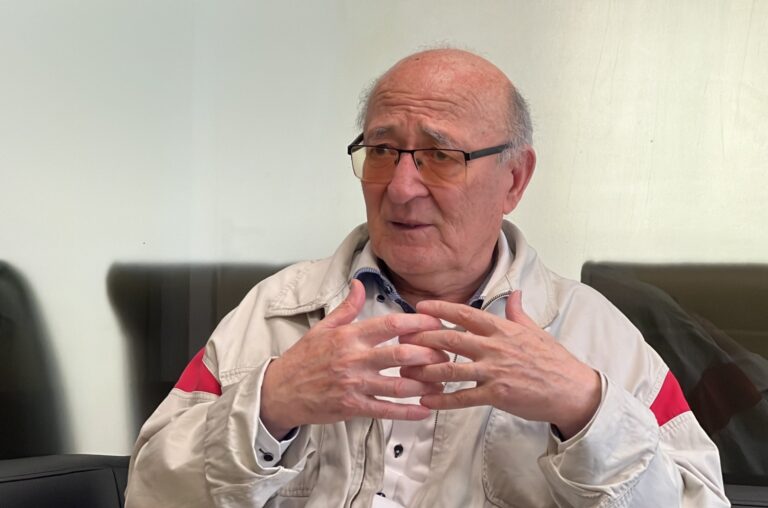
DUSHANBE, November 10, 2010, Asia-Plus — Current electricity prices are too low and do not ensure regular work of the country’s power system, Georgy Petrov, the head of the hydropower engineering laboratory within the Institute for Water Problems of the Academy of Sciences, said.
He considers that it is necessary to raise the rate for residential customers at least up to 3 cents (13.1 dirams) per one kWh of electricity starting from the next year.
“Current rates are too low and Barqi Tojik (Tajik electricity supplier) is forced to take loans to purchase new equipment, modernize the capacity of existing power plants and even to pay for electricity generated by the Sangtuda-1 hydroelectric power plant (HPP),” said Petrov, “We will have to recoup the investments we are currently making sooner or later.”
The expert says there is a great deal of talk about high rates for residential customers. “According to the statistical data from Barqi Tojik, the public consumes on average up to 3 billion kWh of electricity per year,” said Petrov, “Barqi Tojik has 3 million residential customers and it means that they consumer on average 1,000 kWh of electricity per year and 83 kWh per month each, while current price for residential customers is 9.0 dirams per one kWh; the amount turns out inconsiderable. People have to spend, for example, for public transport several times more.”
He agrees that it is necessary to compensate vulnerable sections of the population for rising rates. “As far as I know, Barqi Tojik uses mechanism of compensating poor families. Several years ago, 500,000 poor families enjoyed such benefits. It is just necessary to correct this compensation mechanism.”
We will recall that the Barqi Tojik head Abdullo Yorov told reporters on October 27 that Barqi Tojik power holding (Tajik electricity supplier) offers to raise electricity rates beginning on January 1, 2011. According to him, they offer to raise electricity rate for residential customers by 20 percent and for legal entities by 25 percent.
Every year, a 25-percent rise in electricity prices is introduced in the country twice a year. This year, the electricity prices were raised by 20-25 percent only once, in January, and current prices are 9.0 dirams for residential customers, 8.2 dirams for the Tajik Aluminum Company (TALCO), 21.3 dirams for other industrial and non-industrial enterprises, 8.5 dirams for federally funded institutions and communal services, and 5.7 dirams for pump stations and electric transport.