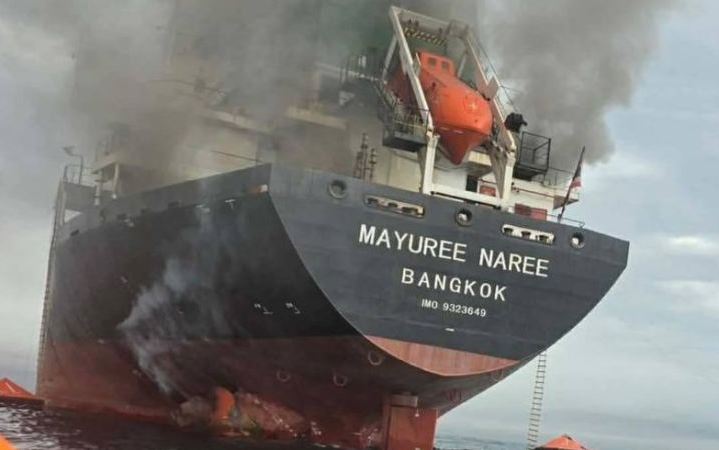
On March 11, several civilian vessels were attacked in the Persian Gulf, including the Strait of Hormuz. DW reports that according to a report from the UK Maritime Trade Operations (UKMTO), three cargo ships were struck by "unidentified projectiles," one of which caught fire.
The Thai Navy confirmed that the burning vessel was the Thai bulk carrier Mayuree Naree, which was hit by a missile in the Strait of Hormuz. All 20 crew members were evacuated by Omani naval forces, with three members reported missing.
Other ships affected by the attacks include the Japanese-flagged container ship One Majesty and the Marshall Islands-flagged bulk carrier Star Gwyneth.
The Iranian Revolutionary Guard Corps (IRGC) acknowledged its involvement in the missile strikes on the Express Rome (Liberia) and the Mayuree Naree after the vessels reportedly ignored warnings. However, Iran denied responsibility for the attacks on the other two ships.
IRGC naval commander Alireza Tangsiri emphasized that passing through the Strait of Hormuz requires Iran's permission.
Additionally, reports indicate that Iran mined the Strait of Hormuz ahead of the attacks. In retaliation, the United States launched strikes on 16 Iranian boats used for mining operations, a move confirmed by U.S. President Donald Trump.
The Strait of Hormuz, a crucial artery for oil transportation from the Middle East, has essentially been closed to civilian vessels since the outbreak of the war. Since February 28, only one tanker has managed to avoid Iranian attacks. The disruption of shipping in the Strait has led to significant spikes in fuel prices.
International response and intervention
In response to the blockade of the Strait, the International Energy Agency (IEA) announced on March 11 a unanimous decision to release 400 million barrels of oil from the reserves of member countries. The IEA, which includes 32 countries from Europe and North America, as well as Japan, South Korea, Australia, New Zealand, Israel, Turkey, and several others, has taken this action in an effort to stabilize global oil markets.
IEA Executive Director Fatih Birol commented, “The scale of the problems we are facing in the oil market is unprecedented, and I am pleased that IEA member countries have responded with urgent, unparalleled measures.”
This marks the sixth joint intervention by the IEA. Previous similar measures were taken in 1991, 2005, 2011, and twice in 2022. The 400 million barrels represent about one-third of the total reserves of IEA member countries. As noted by the BBC, the world consumes 400 million barrels in about four days, while under normal conditions, this amount of oil would pass through the Strait of Hormuz in 20 days.
UN Security Council Resolution
Meanwhile, the UN Security Council adopted a resolution calling on Iran to cease its attacks on third countries. The document, proposed by Bahrain on behalf of the member states of the Gulf Cooperation Council (GCC), was approved by 13 votes, with Russia and China abstaining.
The resolution also condemns any actions or threats by Iran aimed at closing or obstructing international shipping through the Strait of Hormuz. Notably, the resolution does not mention U.S. and Israeli strikes on Iran.