According to a large-scale survey conducted last year among 10,000 citizens of Tajikistan, the healthcare sector ranked third in the overall index of corrupt structures. Approximately 16.7 percent of all respondents who encountered corruption identified structures in this sector.
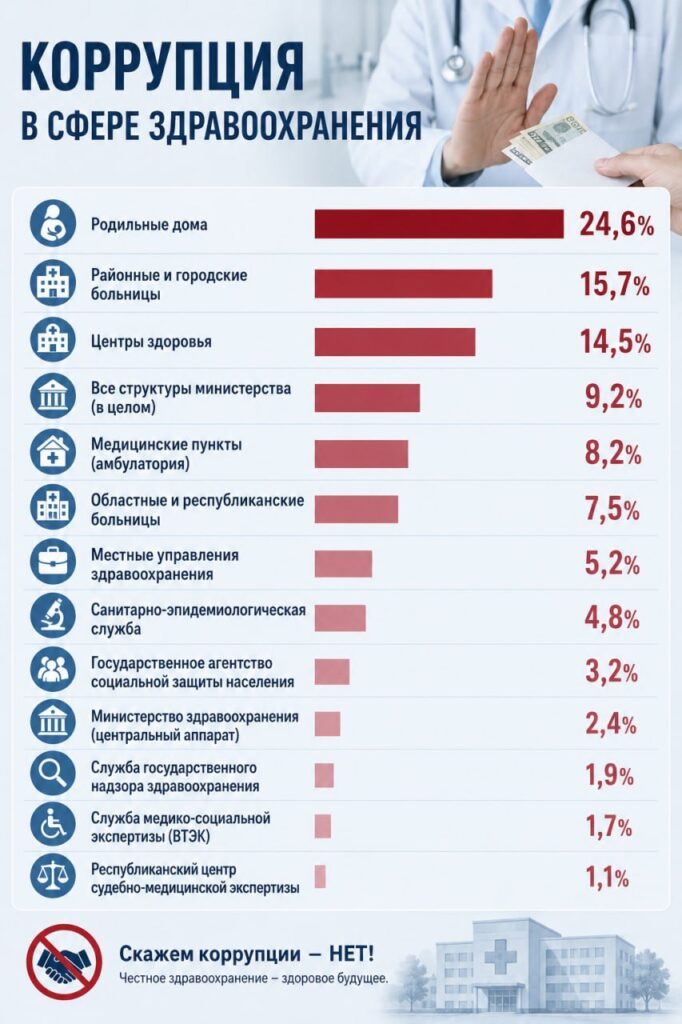
Among all those who encountered corruption in the healthcare sector, 24.6 percent identified maternity hospitals as corrupt. This is the highest rate within the sector.
District and city hospitals with 15.7 percent and health centers with 14.5 percent are in second and third places.
Further details on all structures in the sector:
«Asia-Plus» reached out to the press center of the Ministry of Health and Social Protection of the Population of Tajikistan to obtain the agency’s position, but no response was received by the time of this news publication. If the agency’s position is provided, «Asia-Plus» is ready to publish it.
According to one survey, the education sector took first place in the overall ranking of corrupt structures. Approximately 20% of respondents said they encountered bribery or extortion when addressing the education sector. The Ministry of Education states that it uses the survey results for analysis and improvement of the sector, but also points to the wide coverage of this sector.
This sociological study also found that the Ministry of Internal Affairs (MIA) occupies the second place in the index of bodies affected by corruption. In particular, out of every 5 people who encountered corruption in the MIA, two gave a bribe specifically to employees of the State Automobile Inspectorate (GAI). The position of this agency on the research results is currently unknown.
Bribery is one of the pressing issues in the country’s society. In this survey, people see the main reason for the spread of corruption in low salaries and difficult living conditions (25.6%). The desire of employees to earn additional income is also named as one of the main factors.
A worrying point is that 86 percent of people encountering corruption do not complain to any authorities.
The reasons vary:
Some people do not know the hotlines;
One group considers filing a complaint a futile effort;
And some others do not trust the authorities themselves.
Despite this situation, more than 60 percent of citizens stated that they are willing to cooperate with the authorities to eradicate this phenomenon.