DUSHANBE, March 12, 2011, Asia-Plus — A massive explosion has struck a Japanese nuclear power plant after Friday”s devastating earthquake and Japanese officials fear a meltdown at one of the plant”s reactors after radioactive material was detected outside it, international media outlets report.
According to the BBC, Japan”s nuclear agency said on Saturday that radioactive cesium and iodine had been detected near the number one reactor of the Fukushima 1 plant. The agency said this may indicate that containers of uranium fuel inside the reactor may have begun melting. Air and steam, with some level of radioactivity, has been released from several of the reactors at both plants in an effort to relieve the huge amount of pressure building up inside.
The Tokyo Electric Power Co, the plant”s operator, said four workers had been injured. It is not yet clear in exactly what part of the plant the explosion occurred or what caused it. Chief Cabinet Secretary Yukio Edano said experts were trying to determine the level of radiation at the site.
Thousands of people have been ordered to evacuate the area within a 10-km radius of the plant.
The Japan Times reported on March 12 that the government declared a state of atomic power emergency Friday after the Tohoku region was hit by what is being called the strongest earthquake in Japanese history and urged around 3,000 residents near a reactor in Fukushima Prefecture to evacuate.
The evacuation advisory was issued for people living within a 3-km radius of the plant, while those living within a 10-km radius were requested to stay home, Chief Cabinet Secretary Yukio Edano said, adding the measure was precautionary.
Edano said one of the reactors cannot be cooled down. He added that no radiation has leaked and the incident poses no danger to the environment at the moment.
Prime Minister Naoto Kan declared the emergency even though no radiation leak has been detected after the magnitude 8.8 quake hit so authorities can easily implement emergency relief measures, Edano told a press conference, according to The Japan Times. The nation has some 50 nuclear reactors and those in the quake-hit zone all reportedly automatically shut down.
In Vienna, the International Atomic Energy Agency is scrambling for details from contacts with Japan”s industry ministry, while saying in a statement that at least four nuclear power plants “closest to the quake have been safely shut down” after the quake.
The 8.9-magnitude tremor struck in the afternoon on Friday off the coast of Honshu island at a depth of about 24 kilometers, 400 kilometers north-east of Tokyo. The BBC reports that scientists say it was nearly 8,000 times stronger than last month”s quake in New Zealand that devastated the city of Christchurch.
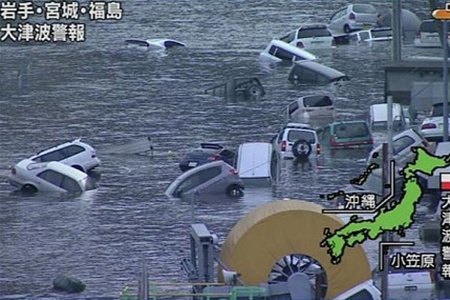
The offshore earthquake triggered a 10-meter tsunami which wreaked havoc on Japan”s north-east coast, sweeping far inland and devastating a number of towns and villages, Reuters reports.
Japanese media estimate that at least 1,300 people were killed and hundred more people are missing.
Reuter says the disaster struck as the world”s third-largest economy had been showing signs of reviving from an economic contraction in the final quarter of last year. It raised the prospect of major disruptions for many key businesses and a massive repair bill running into tens of billions of dollars.
The earthquake was reportedly the fifth most powerful to hit the world in the past century. It surpassed the Great Kant quake of September 1, 1923, which had a magnitude of 7.9 and killed more than 140,000 people in the Tokyo area.
The 1995 Kobe quake caused $100 billion in damage and was the most expensive natural disaster in history, according to Reuters.
A huge relief operation is under way and some of search and rescue teams from around the world are now on their way to Japan.