DUSHANBE, September 5, 2012, Asia-Plus — Deputies of Tajikistan’s lower house (Majlisi Namoyandagon) of parliament have unanimously endorsed the new edition of the country’s tax code.
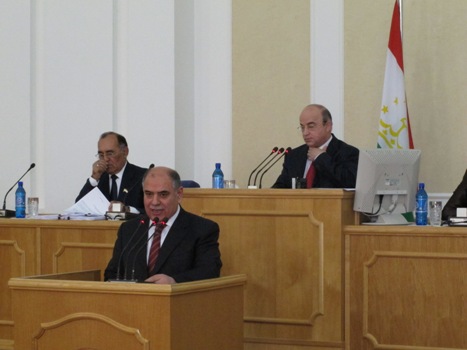
An extraordinary session of the Majlisi Namoyandagon, presided over by its head, Shukurjon Zuhurov, took place on September 5.
Presenting the new edition of the Tax Code, Minister of Finance Safarali Najmiddinov noted that a special commission had been set up to work out the new Tax Code.
The commission members included representatives from the government, private sector, and public associations. “In all, the commission held 45 meetings; two of them were attended by the head of state,” the minister said.
To work out the new edition of the tax code, the commission members reportedly studied an experience of Georgia and took into consideration views of experts from international financial institutions.
Najmiddinov noted that the number of articles in the Tax Code of Tajikistan was reduced from 271 to 229 and the new Tax Code offers the considerable reduction in the number of types of taxes by half — from 21 to 10. Retail sales tax and highway use tax were abolished, while some types of taxes were unified, he said.
“For the purpose of supporting domestic producers the new tax code provides for exempting all the imported state-of-the-art equipment and technologies for production of commodities and services from paying value added tax (VAT) and customs duties,” noted the minister. “Besides, domestic enterprises dealing with processing wool, leather and farm produce will be exempted from paying all types of taxes during the first five years since they are launched irrespective of forms of property.”
Najmiddinov also noted that the revenue part of the national budget will receive at first up to 850 million somoni (equivalent to more than 170 million U.S. dollars) less annually. The minister, however, expressed confidence that putting the new tax code into effect will result in the number of taxpayers increasing in the country.
The new tax code is expected to be introduced gradually from 2013 to 2017.