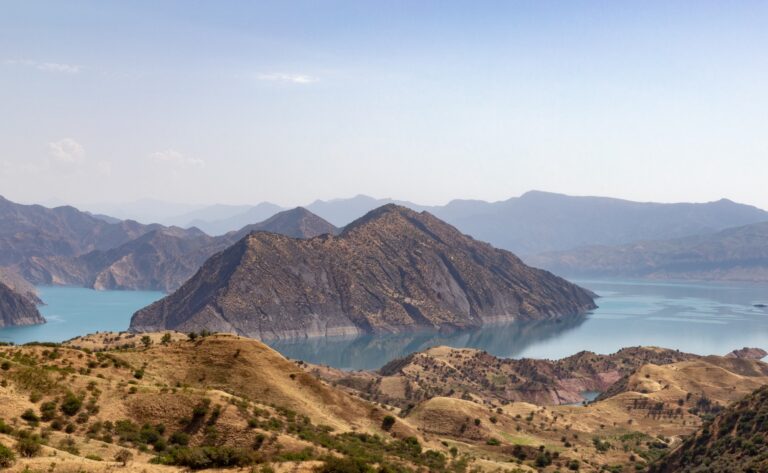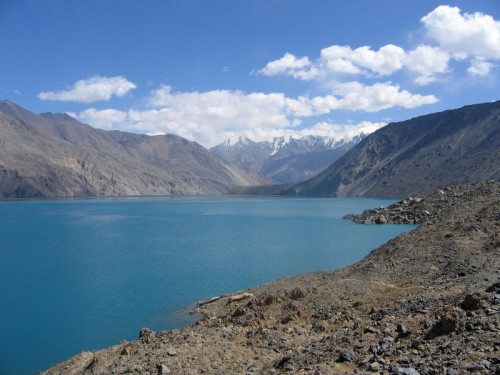
DUSHANBE, July 16, 2013, Asia-Plus – Some Tajik officials want to harness the existing risks, and turn them to the country’s advantages.
Thus, speaking at a news conference in Dushanbe, Talbak Salimov, the head of the Committee for Environmental Protection under the Government of Tajikistan, in particular, noted on July 16 that Tajikistan could lower the water level at Lake Sarez through selling its water to countries experiencing water shortage.
“Of course, if any country expresses intention to buy water of Lake Sarez, we will not be against that. The most important thing is to solve the Lake Sarez problem as soon as possible, because it is a hazardous area. We do not know when they tragedy may occur – today, tomorrow, in a year or in 100 years,” Salimov noted.
According to him, pumping water out of Lake Sarez will not affect the environmental situation in the region, because Tajikistan has enough fresh water resources.
The lake was in 1911 after a landslide triggered by an earthquake. For many years, scientists have been concerned that the earthen dam created by the landslide could break, sending the water from the 75-kilometer-long lake into populated areas and ultimately into the Amu Darya, with catastrophic results for not only Tajikistan, but also for Uzbekistan, Afghanistan, and Turkmenistan. Some 6 million people live in the area that could be affected.
We will recall that Dushanbe hosted several conferences on Lake Sarez to discuss results of scientific researches and long-term solutions to the threat.
Thus, some experts at the conference that took place in May 2007 proposed the construction of a safety-valve tunnel which could divert water into the Murghab River. Others proposed construction of a hydro-electric plant. A feasibility study suggests the combination of a safety-valve and power plant could cost almost $300 million, and would cause the lake level to drop roughly 50 meters.
President Emomali Rahmon suggested the construction of a water pipeline that would serve all of Central Asia. He suggested this during his address to a joint session of parliament on April 30, 2007. He said that Tajikistan backs the creation of a Central Asian consortium to resolve water and energy transportation issues in the region. Noting that the Sarez Lake contains 17 billion cubic meters of “pure and high-quality water,” Rahmon suggested a pipeline from the lake to supply neighboring regions with water.
To better understand the inherent risks posed by Lake Sarez, the Government of Tajikistan and a number of international development partners and scientific organizations gathered in Dushanbe in September 2011 to exchange ideas, to develop options to mitigate the potential risks, and to explore various options for benefiting from the Lake’s water resources. Some participants at that conference noted that if Tajikistan manages to arrange the sale of Lake Sarez’s water, the national budget will receive up to 100 million USD from that per year.
Over the past decade, the Aga Khan Development Network (AKDN), with the support of international partners including the United States Agency for International Development, the Swiss Development Corporation, the Japan Social Development Fund, and the World Bank, among others, have been working to implement projects that promote disaster risk reduction, community resilience and economic development in locales neighboring Lake Sarez.
For instance, projects such as the “Lake Sarez Risk Mitigation” and “Reducing Poverty in High Mountain Environments around Lake Sarez” are key examples of such initiatives addressing the needs of these affected isolated and remote communities. FOCUS Humanitarian Assistance – Tajikistan (an affiliate agency of the AKDN) facilitated the creation of irrigation channels to reduce the water seepage that commonly leads to landslides, and strengthened the emergency response capacity through several village level initiatives such as the installation of new emergency communication equipment, establishments of safe havens and emergency stockpiles.