
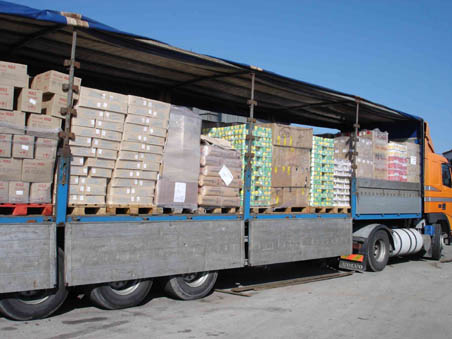
DUSHANBE, November 12, 2013, Asia-Plus — Humanitarian aid was sent to the earthquake-affected people in Vahdat today.
Orif Nozimov, a spokesman for the Committee on Emergency Situations under the Government of Tajikistan, says the assistance included 7.5 tons of wheat flour, 3.75 tons of sugar, 3.75 tons of rice, 1.5 tons of vegetable oil, 1.5 tons of sugar, 1.5 of macaroni, 110 warm tents, and 110 stoves.
The November 10 earthquake reportedly destroyed 118 homes and partially damaged 259 homes in the villages adjacent to the Vahdat Township. Twelve persons have sustained various injuries in the earthquake.
The epicenter of the earthquake, which had a magnitude of 5.0 on the MSK-64 scale, was near the village of Andigon in Vahdat, some 26 kilometers southeast of Dushanbe. In Dushanbe, the quake reportedly measured 4.0 on the MSK-64 scale.
The Medvedev–Sponheuer–Karnik scale, also known as the MSK or MSK-64, is a macroseismic intensity scale used to evaluate the severity of ground shaking on the basis of observed effects in an area of the earthquake occurrence. The scale was first proposed by Sergei Medvedev (USSR), Wilhelm Sponheuer (East Germany), and Vit Karnik (Czechoslovakia) in 1964. It was based on the experiences being available in the early 1960s from the application of the Modified Mercalli scale and the 1953 version of the Medvedev scale, known also as the GEOFIAN scale.
With minor modifications in the mid-1970s and early 1980s, the MSK scale became widely used in Europe and the USSR. In early 1990s, the European Seismological Commission (ESC) used many of the principles formulated in the MSK in the development of the European Macroseismic Scale, which is now a de facto standard for evaluation of seismic intensity in European countries. MSK-64 is still being used in India, Israel, Russia, and throughout the Commonwealth of Independent States (CIS).
The MSK scale is somewhat similar to the Modified Mercalli (MM) scale used in the United States. The MSK scale has 12 intensity degrees.
