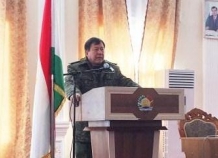
DUSHANBE, December 15, 2015, Asia-Plus – A deadly mutiny by former deputy defense minister Abduhalim Nazarzoda that left more than 20 people dead in and around Dushanbe in September was financed by the banned Islamic Revival Party (IRP), Interior Minister Ramazon Rahimzoda noted at a meeting with residents of the Roshtqala district in the Gorno Badakhshan Autonomous Region (GBAO) on December 14, according to the Interior Ministry’s website.
The minister reportedly noted that owing to cooperation between the law enforcement agencies ad ordinary people the operation to eliminate the terrorist group had ended in 10-12 days.
Speaking at the meeting, Rahimzoda also said that more than 600 Tajik nationals are currently fighting alongside militants in Iraq and Syria.
According to him, 50 Tajik nationals have voluntarily returned home as the result of Tajik authorities” appeal” on Tajiks fighting abroad to leave Syria and Iraq and surrender to Tajik authorities to avoid prosecution.
The minister said the Tajik authorities would continue work on returning Tajik militants who are fighting abroad.
We will recall that the authorities have arrested 23 leading members and activists of the IRP, alleging their direct involvement into the mutiny”s masterminding.
Tajikistan’s Supreme Court on September 29 banned the Islamic Revival Party as terrorist group on the basis of a suit filed by the Prosecutor-General’s Office. The verdict forces the closure of the IRPT”s official newspaper
Najot
(Salvation) and bans the distribution of any video, audio, or printed materials related to the party”s activities.
Founded in October 1990, the Islamic Revival Party of Tajikistan is the only Islamic party officially registered in former Soviet Central Asia. The IRP was registered on December 4, 1991. It was banned by the Supreme Court in June 1993 and legalized in August 1999. According to some sources, the IRP now has some 40,000 members.
Since 1999, the party had reportedly been the second-largest party in Tajikistan after the ruling People”s Democratic Party of Tajikistan.
In the 2005 and 2010 parliamentary elections, the IRP won two out of 63 seats in the parliament, but the party suffered a crushing defeat in Tajikistan”s March 1 vote, failing to clear the 5 percent threshold needed to win parliament seats.