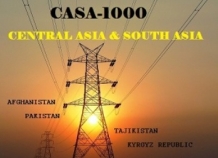
DUSHANBE, May 13, 2016, Asia-Plus – The World bank notes that the CASA-1000 project is the first step towards creating the Central Asia-South Asia Regional Electricity Market (CASAREM), leveraging Central Asia”s significant energy resources to help alleviate South Asia”s energy shortages on a mutually beneficial basis.
CASA-1000 will put in place the contractual and institutional arrangements, and the transmission infrastructure, to facilitate the export of 1,300 megawatts (MW) of already available surplus electricity in the summer months from Kyrgyzstan and Tajikistan to Afghanistan and Pakistan. CASA-1000 will be compatible with, and complement, other on-going or planned transmission investments in the four countries. “Open access” mechanisms will allow other interested exporters (Turkmenistan, Uzbekistan, Kazakhstan or the Russian Federation) to use any available transmission capacity, for example, in the winter months.
By enabling regional electricity trade and paving the way for other trade/transit infrastructure investments in the region, CASA-1000 will help alleviate poverty in some of the poorest parts of the world while also enhancing energy security and regional stability, according to the World Bank.
An update to the original feasibility report in February 2011 showed that for the 20-year study horizon (2016-35) both Kyrgyzstan and Tajikistan will continue to have sufficient summer-time (defined as May 1 to September 30) hydropower surpluses to export to South Asia without adding new power generation capacity.
Tajikistan is currently spilling a lot of water in the summer without generating any electricity, as the inflows are much larger than the domestic demand and current exports. Sufficient quantities of surplus hydropower are available during the summer months to meet the export commitments made under the project, without adding any new power generation to the system.
The countries have committed to meeting the downstream water commitments and ensuring that the project commitments do not affect domestic supply. The project’s commercial framework, negotiated between the exporting and importing countries governing the supply of electricity, is designed to suit this variability in the export quantities. The legal commitments are based on average export quantities over each 5-year block, thereby allowing for some variability each year. Additional energy can be supplied during extreme wet years.
The World Bank says that the sale of electricity will only be from surplus summer generation during the months from May 1 to September 30. This surplus summer hydropower is otherwise wasted; its export will not affect winter generation or make shortages worse. The project will help alleviate winter shortages because the revenues from exports are expected to be invested in activities that mitigate the shortages. Because the project will allow open access, Tajikistan and Kyrgyzstan may also import winter electricity through the line.
We will recall that the launch ceremony of the CASA-1000 project took place in the Tajik city of Tursunzoda on May 12. On May 11, a roundtable on “CASA-1000 and Prospects for the Development of Regional Energy Cooperation” was organized by the Ministry of Foreign Affairs of Tajikistan in Dushanbe.