
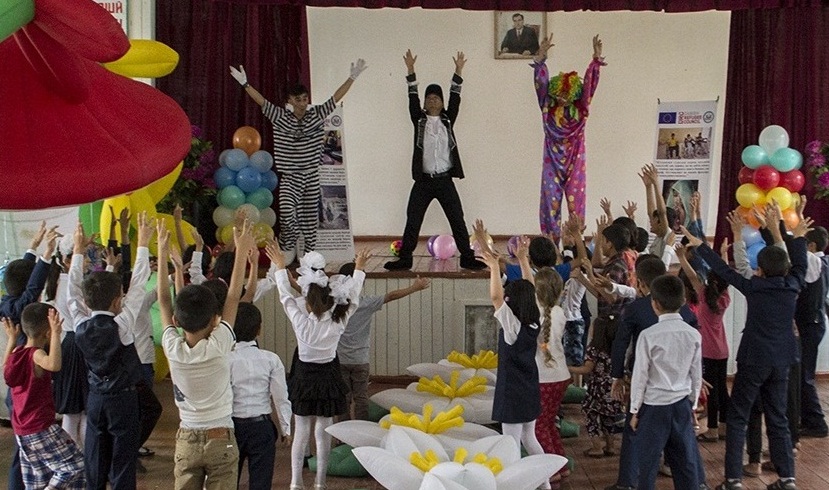
This year Danish Refugee Council (DRC) in partnership with the NGO “Refugee Children and Vulnerable Citizens (RCVC)” celebrated “World Refugee Day” on June 1–2, 2016 in two schools of Vahdat city, focusing on the integration of refugee’s children into Tajik society. According to the latest data, around 2200 refugees are residing in Tajikistan, where 99% of them are Afghans.
First day of the event was focused on primary grades of school № 5 with a special entertainment program designed for children of that age. The joyful celebration for more than sixty children included a program with variety of games, contests, and quizzes. The most exciting part of the event came to be a game with colors, so called “Unconventional Painting” where children dipped their palms in the paints and left their prints on the provided big banners.
The next day of the event was celebrated with the children of secondary grades from school № 1 targeting around forty students. Sports and intellectual activities was offered to students, where the winners were awarded with gifts. The majority students of these schools are children of Afghan refugees, some of whom were born in Tajikistan and some have crossed the border with their parents escaping conflict and disparity back in Afghanistan and seeking asylum in Tajikistan.
Most of DRC projects in the last years have been implemented with the financial support of the European Union and one of the focus has been integration of refugees into the local community. In general, integration is a lengthy process and requires great amount of social interaction between the refugees and local population. In this regard, this year celebration was decided to be commemorated with schoolchildren of both Afghan and Tajik nationality, where most social interaction comes into place and an opportunity for parents to bond even better.
DRC has started its operation in Tajikistan since 2011 and provides support to two target groups: 1) refugees and asylum seekers and 2) stateless persons. Capacity building activities of DRC are aimed at raising awareness on national law and international standards applied to refugees and implemented through providing training to judicial and executive authorities – judges, prosecutors, law enforcement officers, border guards, and police. In 2016 alone, 800 duty bearers have been capacitated by DRC throughout the country.
Day to day challenges faced by refugees are mainly related to employment, housing, interaction with local community and language barrier. To support the betterment of refugees’ life, DRC organized a two months vocational training courses on various subjects, including hairdressing, baking, sewing, and mechanics. To further their entrepreneurial skills, DRC also conducted business-training courses to the selected refugees and provided the graduates with small grants to start up their own business. As a result, out of 84 refugee applicants, who applied for the DRC’s small grants project, 36 were successful beneficiaries. The aim of this initiative was to support refugees not only to integrate into the community, but also to assist them with improving their lives.
DRC also provided the Refugee Citizenship Unit of Ministry of Internal Affairs with computers and internet connection in order to support the ministry with access to information online while identifying the country of origin information about new arrived refugees.
The Danish Refugee Council (DRC) is a private, humanitarian organization founded in 1956. In Tajikistan, DRC’s work focuses on improving the protection and livelihoods of refugees and asylum seekers, enhancing the capacity of immigration authorities, and strengthening civil society. The majority of asylum seekers and refugees in Tajikistan are from neighboring Afghanistan. As an integral part of the regional strategic response to Afghan displacement, a large part of DRC’s work in Tajikistan aims at improving the protection and livelihoods of Afghan refugees and asylum seekers. Mobilization of the Afghan refugee communities plays a pivotal role in this effort, ensuring the target group’s participation and ownership and DRC strives to increase the capacity of refugee communities to advocate for their rights and address their own protection needs.