Jesus Christ's tomb uncovered for first time in centuries in hunt for secrets of how and where he was buried.
Researchers working at the holy site in Jerusalem have exposed the original rock tomb for the first time since at least 1555.
Scientists working at what is believed to be the burial site of Jesus Christ have uncovered his original tomb for the first time in centuries.
The grave, inside the Church of the Holy Sepulchre in the Old City of Jerusalem, Israel, has been covered in marble since at least 1555 AD – and possibly centuries earlier, according to Independent.
It was exposed on October 26 as part of a major restoration project at the church.
But now archaeologists have removed the slabs and exposed the original, rock-carved tomb that Christ is believed to have been buried in. They are conducting further tests to establish more about where and how he was buried, National Geographic reports.
According to Christian tradition, Christ was buried in a limestone tomb made of rock hewn from the side of a cave after he was crucified by the Romans in 30 AD.
Christians believe he was resurrected after his death, with the Bible recounting that women who went to see him three days after the burial found no remains in the cave.
The new excavation of the site, which is the most holy in Christianity, is being carried out by a team from the National Technical University in Athens that has previously led restoration work on the Athenian Acropolis and the Hagia Sophia in Istanbul.
Beneath the marble covering, they discovered a “fill” layer of rubble and a grey stone surface, the nature of which is unknown but undergoing tests.
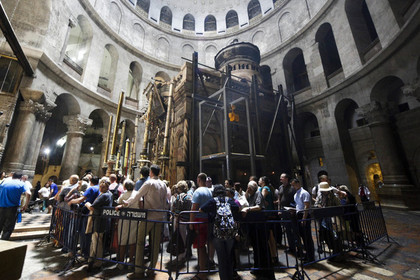
National Geographic reports that a transparent window has been cut into the Edicule’s interior wall to expose one of the cave walls.
“This is the Holy Rock that has been revered for centuries, but only now can actually be seen," the project’s Chief Scientific Supervisor Professor Antonia Moropoulou told National Geographic.
The Gospels say that Jesus was buried outside Jerusalem’s city walls, which was in keeping with Jewish tradition, and near Golgotha, the site of his crucifixion. Jerusalem’s walls were later expanded to place Golgotha and the tomb within the city.
“We know that this area was a Jewish cemetery at the time of Jesus,” Jodi Magness, archaeology professor at the University of North Carolina at Chapel Hill, who is not involved in the Church of the Holy Sepulchre project, told FoxNews.com. Magness noted that other tombs are located in the immediate vicinity
Archaeologist Martin Biddle, who is an expert on the Church of the Holy Sepulchre, told National Geographic that data from the burial bed and cave walls should be carefully analyzed, as any graffiti could provide vital clues to the tomb’s history.
The work is reportedly part of a $4 million project to restore the tomb and the small structure, called the Edicule, in which it is enclosed. The research has in part been funded by King Abdullah II of Jordan.
“We are at the critical moment for rehabilitating the Edicule,” said Professor Antonia Moropoulou. “The techniques we're using to document this unique monument will enable the world to study our findings as if they themselves were in the tomb of Christ."
The tomb was uncovered after the church was closed early to the many tourists and pilgrims who visit the site every day. The candles that usually light the sacred Edicule were replaced with bright construction lights, allowing hard hat-wearing researchers to reveal previously unseen details.
The Church of the Holy Sepulchre was first built in 335 AD and forms the heart of the Christian Quarter within the walled Old City of Jerusalem. It is jointly managed by representatives of six different Christian denominations, with the Greek Orthodox Church, the Roman Catholic Church and the Armenian Church having the most influence.
Disagreements over the running of the site have led to a number of disagreements, including brawls between rival monks.
Because no part of the church can be modified without the agreement of all the different communities, much-needed restoration work is often prevented, according to Independent.
The keys to the church have been in the possession of a Muslim family since the 12th Century.