Japan’s Government has completed five Grant Assistance for Grassroots Human Security (GGP) Projects in the Rasht Valley (eastern Tajikistan).
According to Japan’s Embassy in Dushanbe, Ms. Chie Tamura, Head of the Economic Cooperation Department of the Embassy of Japan in Dushanbe, attended five handover ceremonies that took place in Sangvor, Rasht, Lakhsh and Nourobod districts from November 8 through November 10.
The total grant amount of USD 675,418 was reportedly provided by the Government of Japan for those five GGP projects. The grant was provided through the scheme of Japan’s Grant Assistance for Grassroots Human Security Projects (GGP).
On November 8, a handover ceremony for “The Project for Support to Mechanical Demining Activities in the Republic of Tajikistan” took place in Sangvor district. The project was conducted by Swiss Foundation for Mine Action (FSD) with the grant amount of USD 272,030. In 2014 and 2015, FSD cleared approximately 371.500 m2 of mine affected areas in Darvoz, Jayhun (former Qumsangir) and Sangvor (former Tavildara) districts and handed over the cleared lands to the local authorities.
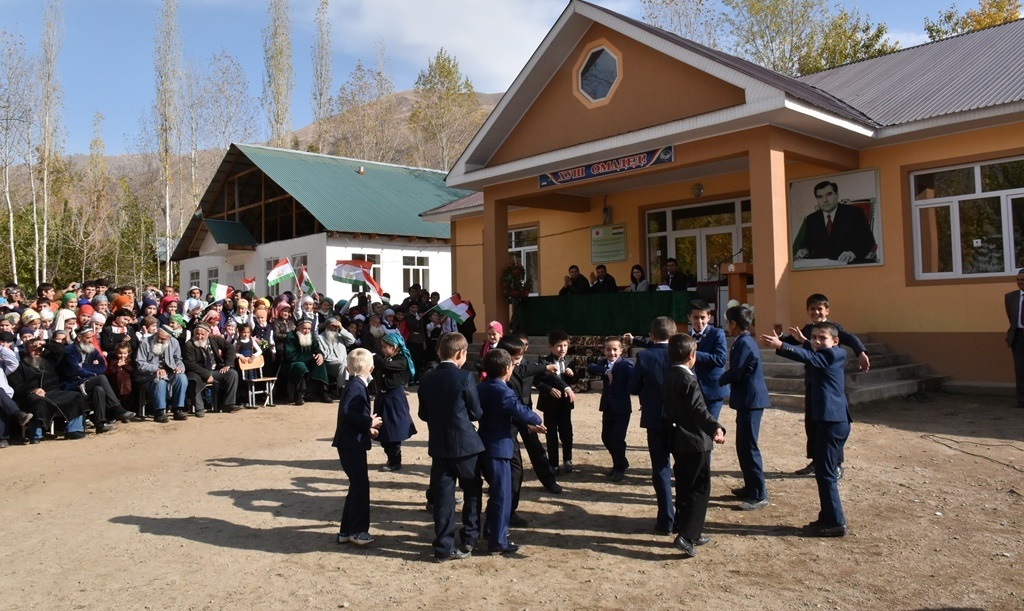
On November 9, a handover ceremony for “The Project for Construction of School Building in Dehai Navbunyodi Halqarf Village, Navdi Jamoat, Rasht District” was conducted in Rasht district. Through the project, the building for the new school in the newly established settlement was constructed. An US$88,110 grant was reportedly provided to the local government of Rasht district for construction of a new school building. Upon the project completion, now the school building consisting of 4 classrooms and 2 staff rooms serves the local community, which can seat 150 elementary school students from 1st through 4th grades. Now the children from Halqarfi Navbunyod Village can enjoy the new learning environment in a comfortable and safe educational facility without having to walk to the neighboring village.
On the same day, Ms. Tamura attended a ceremony for the completion of “The Project for the Refurbishment of Support Centers for Children with Disabilities in Rasht District.” The local government of Rasht District received USD 102,371 for rehabilitation of the daycare center for disabled children and a building within the Rasht district central hospital that offers psychological, medical, and diagnostic consultation to the children with disabilities. In addition, necessary equipment was also provided through the project. The project contributed to improving the quality of care provided for the children with disabilities in Rasht District.
Following Rasht district, Ms. Tamura took part in a handover ceremony for “The Project for the Improvement of Irrigation System in Qarasoy and Qashot Villages, Qashot Jamoat, Jirgatol District” in Lakhsh (former Jirgatol) district. The grant of US$114,756 was provided to the local authorities for improvement of the agriculture sector in Lakhsh district. The project included rehabilitation and construction of two pump stations and irrigation pipe system, as well as construction of a pedestrian bridge in Qarasoy and Qashot villages. With the project completion, agricultural productivity of the area is expected to grow significantly.
Lastly on November 10, a handover ceremony for “The Project for Construction of School Building for School No. 25 in Zoron Village, Mujiharf Jamoat, Nourobod District” was conducted. For implementation of the project, a US$98,151 grant was awarded to the local authorities. Through the project, a new additional school building for School No. 25 with five classrooms and one teacher’s room was constructed. Now, around 400 students can study in the new school building with spacious classrooms, contributing to creating better educational environment for the young generation in the area.
Grant Assistance for Grassroots Human Security Project (GGP) is a scheme within Japan’s Official Development Assistance. GGP in particular implements grassroots-level projects in various sectors throughout Tajikistan. Recipients of GGP grants include local governments, educational and medical institutions, and NGOs. As of today, GGP has supported 352 projects in Tajikistan, for which US$ 28.5 million has been allocated since 1996.