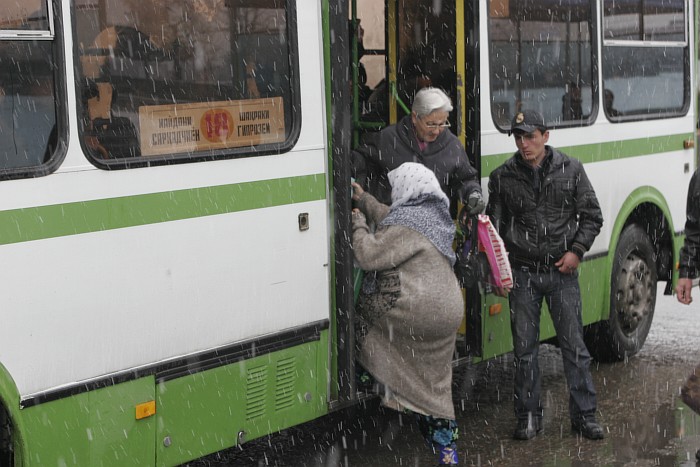
An innovation has been introduced in Dushanbe’s public transport today. Thus, divers of fixed-route minivans now propose to listen songs about the Homeland and the Leader of the Nation.
Such an innovation has been introduced in fixed-route minivans ## 25, 2, 35, 15, 13, and 46.
One of drivers told Asia-Plus on an anonymous basis that they purchase flash cards containing patriotic songs for 35 somoni in companies for which they work.
An official source at Dushanbenaqliyotkhizmatrason (public transport service) has told Asia-Plus that “such practice will be used on other routes as well.”
Currently, on average 197 buses, 60 trolleybuses, 50 fixed-route minivans and more than 2,200 private taxies are running within Dushanbe every day.
As it had been reportedly earlier, Dushanbe authorities intend to remove fixed-route minivans from the city streets in the first half of 2017.
They are expected to be replaced with buses and trolleybuses; private taxies will also remain in the city, Ghayurbek Iskandarov, the head of Dushanbenaqliyotkhizmatrason, told Asia-Plus on January 20.
“This decision is aimed at reducing traffic flow and traffic jams in the city,” Iskandarov said, noting that more than 3,031 minivans are currently running in the city.
“We intend to replace eight minivans with one bus or trolleybus,” said the Dushanbe transport official. “The new buses and trolleybuses are expected to arrive in Dushanbe in April or May.”
He further added that the Dushanbe administration would announce an international tender for selection of passenger transport supplier.
Meanwhile, for many Dushanbe drivers, these minivans became an important source of income. Many of them took out loans to buy the vehicles while others leased them.
Recall, the Tajik authorities in 2010 banned drivers of eight-seat Chinese Hafei minivans from carrying passengers in the capital Dushanbe, putting out of work hundreds who used these relatively affordable vehicles to ferry residents around the Tajik capital. The authorities said the ban was motivated by passenger safety concerns, contending that the minivans were a source of frequent traffic accidents.
But in tandem with the ban, more spacious, comfortable and safe Hyundai and Mercedes vans replaced the Chinese minivans.
When the Chinese minivans first appeared on the streets of Dushanbe around 2006, drivers and passengers affectionately dubbed them the Tangem, named after a female Korean soap opera star popular on local television.