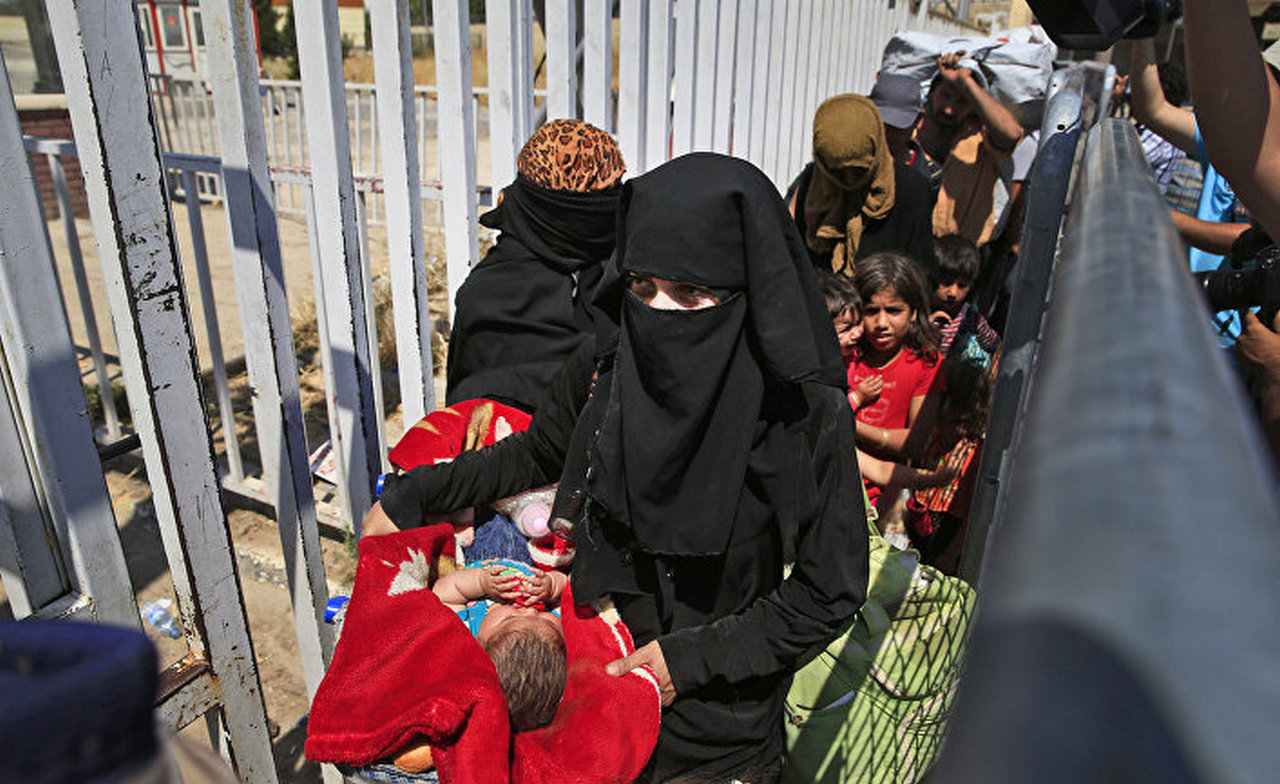
Reuters news agency reports that Iraqi authorities are holding 1,400 foreign wives and children of suspected militants of the Islamic State (IS) terror group. The news agency, citing security and aid officials, on September 10 said many of those detained came from Turkey, while others came from Tajikistan, Azerbaijan, and Russia. Some were also from Asia and a "very few" were French and German citizens, the report said.
Reuters said the detainees were wives and children of IS militants driven out by government forces from their last strongholds, including Mosul.
The women and children are reportedly being held at a camp south of Mosul. One intelligence officer said the authorities were still attempting to confirm and verify their identities with their home countries, as most did not have their original documents.
Iraqi Army Colonel Ahmad al-Taie told Reuters the army was holding families of extremists and awaiting government orders.
Meanwhile, Radio Liberty’s Tajik Service, citing a source at the Prosecutor-General’s Office of Tajikistan, says Tajik authorities intends to return wives and children of Tajik militants fighting alongside the IS terror group in Iraq and Syria to Tajikistan.
According to the source, the Tajik authorities are currently studying the experience of Kazakhstan in returning children and wives of Kazakh IS militants to the country. Special groups are reportedly working in Kazakhstan on returning the abandoned families of IS militants to the country. Members of these groups are traveling to Syria and Iraq to identify Kazakh nationals.
According to the Tajik authorities’ data, more than 250 Tajik children are currently present in Syria and Iraq.
The report released by the Tajik government for the UNHCR this summer, in particular, says there are currently 234 Tajik families in Syria and Iraq, totally 840 people in all. That number includes 309 men, 279 women, 110 girls and 142 boys.
Over the last 30 months, the Tajikistan report says, 19 families have returned from the fighting. Among them were 21 girls and 20 boys. Earlier this year, Ms. Rajabmo Badriddinova, children’s ombudsman for that country, said that “dozens” of Tajik families had gone to fight for IS militant group but that the authorities had little information about them.