Human Rights Watch (HRW) on September 24 released an open letter to Interpol secretary-general on the occasion of Interpol’s 86th General Assembly, which will convene in Beijing from September 26-29, 2017.
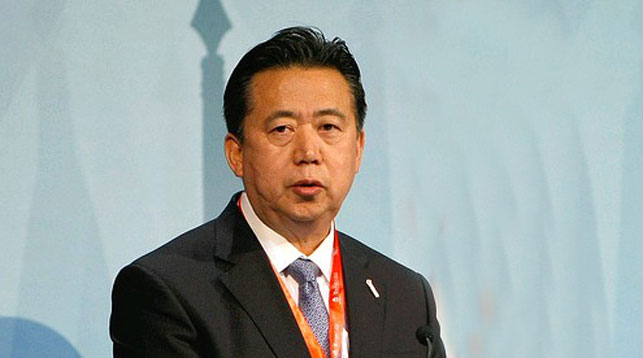
HRW is concerned about instances in which China appears to have misused Interpol’s “red notice” system, and about Interpol’s ability to adhere to human rights obligations under the leadership of the new president, Meng Hongwei, the vice minister of the Chinese Ministry of Public Security.
For three decades Human Rights Watch has reportedly documented widespread human rights violations by China’s police with almost complete impunity.
In recent years, Human Rights Watch has documented several of these cases, including China’s use of a police operation known as “Fox Hunt” or “Skynet,” in which China has brought back hundreds of allegedly corrupt officials living overseas, often from jurisdictions with weak legal systems, according to the letter.
In recent years, the Chinese government, against Interpol’s regulations, has reportedly tried to control and persecute dissidents and activists abroad by issuing politically motivated red notices through Interpol.
The letter says China has claimed on a number of occasions that it has issued a red notice against Dolkun Isa, a well-known activist who campaigns from Germany on behalf of Uyghur minorities. Isa was granted refugee status in Germany in 1996 and subsequently was naturalized as a German citizen; he was first made aware by German police in 1999 that a red notice for him existed. In a 2016 press conference, a spokesperson for the Chinese Foreign Ministry said Isa was “wanted by the Interpol for severe criminal and violent terrorist activities including bombing, robbery and murder… in Central Asia and in China.” Isa denies these allegations, and wishes to challenge the designation—but even that process requires China’s cooperation.
China also issued a red notice against Chinese activist Wang Zaigang. Wang, after moving to the United States in 2014, has been active in the overseas Chinese democracy movement. According to the red notice, authorities in Wang’s home province of Heilongjiang province charged him in 2015 with “submitting tenders in collusion” in connection with a contract bidding for the construction of a hospital ward in the province. Wang’s lawyer, Li Jinjin, told Human Rights Watch that Wang was not in any way involved in the business activity cited in the red notice. Li said Wang believes the red notice was in retaliation for his pro-democracy activism in the United States, particularly the protest he participated in Seattle in September 2015 when President Xi visited the city.
In June 2016, US immigration authorities acted on the red notice and arrested Wang. In March 2017, a federal immigration court in Hawaii granted Wang asylum. Li said neither she nor Wang has contacted Interpol to request the removal of the red notice against Wang. It is unclear whether the notice is still in effect.
HRW is reportedly also concerned about the ability of Meng Hongwei, who assumed Interpol’s presidency in November 2016, to maintain Interpol’s neutrality, and to respect and protect human rights in the organization’s activities and strategies.
Meng at the same time is a vice minister in the Chinese Ministry of Public Security.
Human Rights Watch urges Interpol to use the occasion of its General Assembly to address the concerns it raises.
Interpol Notices are international requests for cooperation or alerts allowing police in member countries to share critical crime-related information.
Notices are published by Interpol’s General Secretariat at the request of National Central Bureaus (NCBs) and authorized entities, and can be published in any of the Organization’s official languages: Arabic, English, French and Spanish.
In the case of Red Notices, the persons concerned are wanted by national jurisdictions for prosecution or to serve a sentence based on an arrest warrant or court decision. Interpol’s role is to assist the national police forces in identifying and locating these persons with a view to their arrest and extradition or similar lawful action.
In addition, Notices are used by the United Nations, International Criminal Tribunals and the International Criminal Court to seek persons wanted for committing crimes within their jurisdiction, notably genocide, war crimes, and crimes against humanity.