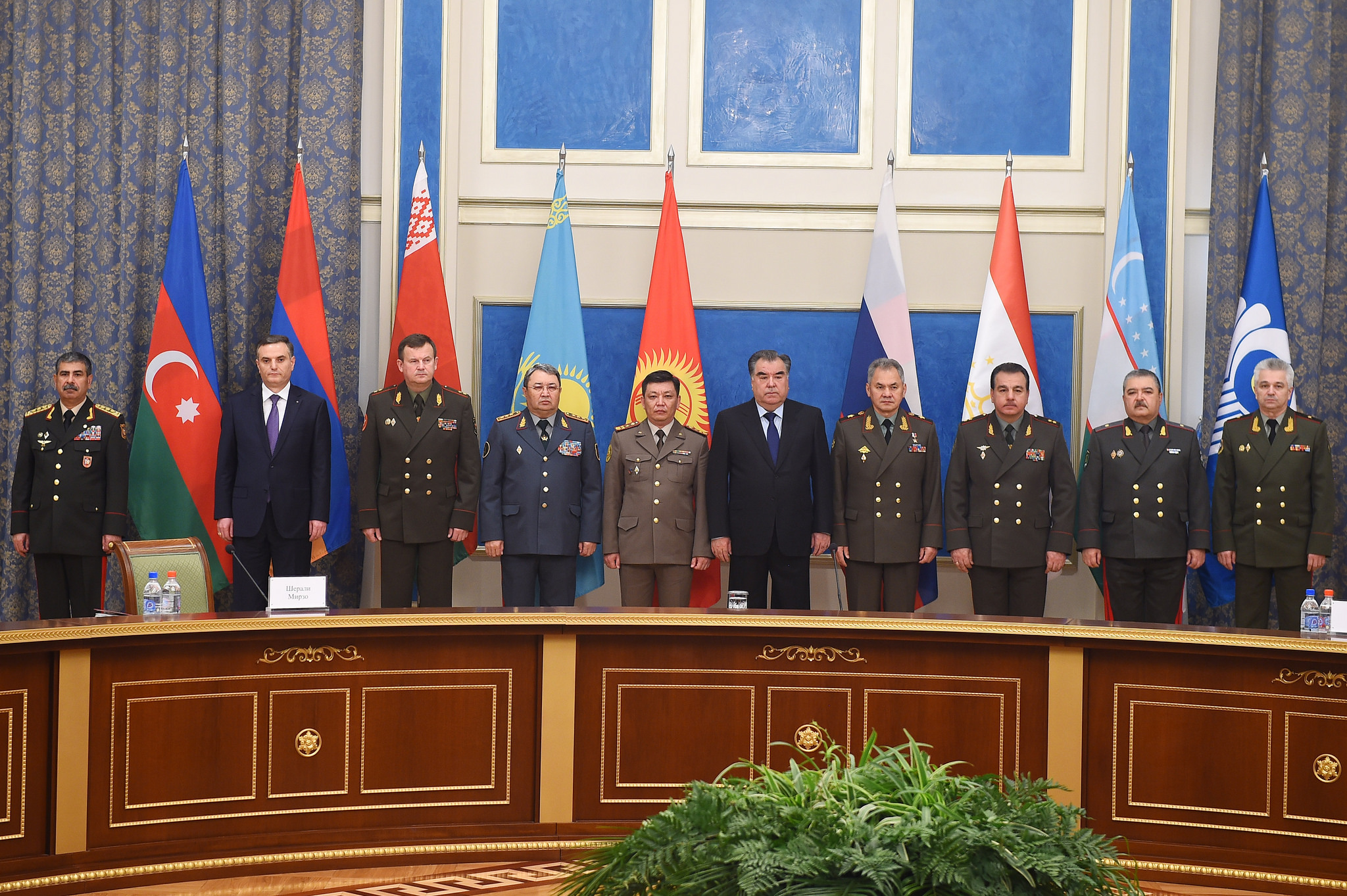
Rahmon receives CIS defense ministers

On Thursday October 12, Tajik President Emomali Rahmon received defense ministers of the CIS member nations who arrived in the Tajik capital for participation in a meeting of the CIS Council of Defense Ministers. According to the Tajik president’s official website, Tajik leader expressed satisfaction with the results of a 25-year work of the CIS […]

Asia-Plus

On Thursday October 12, Tajik President Emomali Rahmon received defense ministers of the CIS member nations who arrived in the Tajik capital for participation in a meeting of the CIS Council of Defense Ministers.

According to the Tajik president’s official website, Tajik leader expressed satisfaction with the results of a 25-year work of the CIS Council of Defense Minister.

The meeting reportedly focused on the issues related to expansion of military and technical cooperation between the CIS member nations in the framework of implementation of the CIS Concept for Military and Technical Cooperation designed for the period till 2020 and the Five-Year Program for Cooperation between CIS Member Countries on Strengthening Security on External Borders designed for 2016-2020. 

Meanwhile, a meeting of the CIS Council of Defense that is going on in Dushanbe today is expected to discuss more than twenty issues.

Representative of Tajikistan will inform the meeting participants about the current situation along Tajikistan’s common border with Afghanistan and its influence on the regional security.

Established on December 1991 after the dissolution of the Soviet Union, the Commonwealth of Independent States (CIS) is a regional organization.  It now consists of Azerbaijan, Armenia, Belarus, Kazakhstan, Kyrgyzstan, Moldova, Russia, Tajikistan, Turkmenistan, Uzbekistan and Ukraine.  Georgia pulled out of the organization in 2009.

In 1992, the CIS Charter establishes the Council of Ministers of Defense, which is vested with the task of coordinating military cooperation of the CIS member states.  To this end, the Council develops conceptual approaches to the questions of military and defense policy of the CIS member states; develops proposals aimed to prevent armed conflicts on the territory of the member states or with their participation; gives expert opinions on draft treaties and agreements related to the questions of defense and military developments; issues related suggestions and proposals to the attention of the CIS Council of the Heads of State.  Also important is the Council’s work on approximation of the legal acts in the area of defense and military development.

Join us on social media!

Article translations:

Related Article

Оби зулол
Оби зулол

Most Read

Recent Articles

The only GPW veteran in Dushanbe allocated more than 80,000 somoni

The mayor's office of Dushanbe allocated him 25,000 somoni.

GITEX AI Kazakhstan 2026: how Almaty became the main AI hub of Central Asia

More than 300 companies and startups, over 200 speakers and 100 investors from 50 countries — the region is entering the global stage.

A trade and economic park to be built at the border junction of Tajikistan, Kyrgyzstan, and Uzbekistan

President of the Kyrgyz Republic Sadyr Japarov familiarized himself with the project.

A project to protect soil from degradation to be developed in Central Asia

The initiative is of great significance for the mountainous countries of the region, including Tajikistan.

Mudslide, death, and destroyed homes: hundreds of families in Tajikistan left homeless

A correspondent from "Asia-Plus" visited Kulob and spoke with the families of those who died and were affected by the disaster.

Spring 2026 bright event: new issue of VIPzone now on sale

This issue is about people and ideas that change everything: from business and investments to fashion, food, and urban environment.

Godfrey Sullivan: “Tajikistan is a promising market for Visa to develop digital payments”

The Vice President of Visa explained why Tajikistan is becoming a promising market for digital payments and how artificial intelligence is influencing the future of finance.

Seven students in Dushanbe were threatened with expulsion for arriving at universities in personal cars

The materials for each case have been sent to the Ministry of Education and Science for appropriate actions.

India’s blockchain push and lessons for the global south

The Indian Government has started pushing aggressively its agenda...

India’s blockchain push and lessons for the global south

The Indian Government has started pushing aggressively its agenda...