An article released by the World Bank on December 11 notes that natural disasters such as landslides and mudflows are frequent across Central Asia.
In Tajikistan, as much as 36 percent of the country’s territory is reportedly under threat from landslides. Kyrgyzstan is prone to avalanches: between 1990 and 2009, the country had over 330 avalanches.
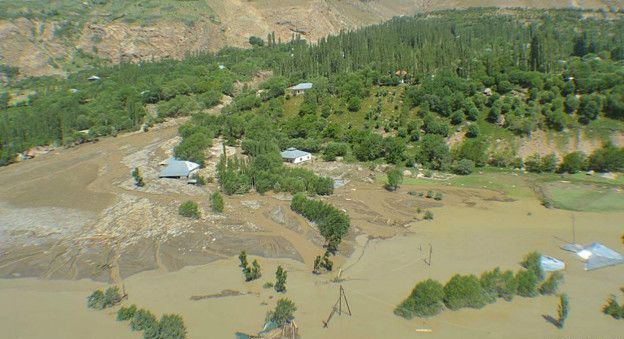
Just two years ago, triggered by sudden rainfall and strong snow melting, a powerful mudflow devastated Barsem, a village in Tajikistan’s Gorno Badakhshan Autonomous Region (GBAO), leaving over 82 families without homes, cutting the local power supply for weeks, and disrupting the country’s only international transit route with China, the “Pamir Highway.”
The threats from mountain hazards are reportedly exacerbated by existing conditions of poverty, insufficient infrastructure and poor resources.
The Central Asian region is also expected to see an increase in extreme weather events in the coming decades. By the end of the century, temperatures in the region will rise by up to 6 degrees Celsius, leading to the disappearance of more than one third of glaciers from Central Asian mountains by 2050, putting nearby communities at greater risk and rolling back hard-won development gains.
To help countries to adapt to a riskier future, the World Bank’s Central Asia Hydrometeorology Modernization Project (CAHMP) is bolstering weather forecasting and early warning efforts in the region. These efforts are particularly important for Tajikistan and Kyrgyzstan, two of the most disaster-prone countries in the region with mountains covering more than 90 percent of their geography.
Funded by the World Bank and the Global Facility for Disaster Reduction and Recovery (GFDRR), this $28 million investment focuses on strengthening hydrometeorological services and generating further climate-related risk information that the region is lacking.
The project provided cutting-edge technical equipment – such as modern workstations, automated observation networks, access to satellite data and numerical weather prediction – coupled with specialized trainings for participating agencies.
Because of these improvements, the forecast accuracy in Kyrgyzstan and Tajikistan reportedly increased by 20 to 30 percent. With access to more accurate risk information, countries can better anticipate extreme weather events and take timely action, such as organizing evacuations for at-risk communities, putting in place protective measures and minimizing potential losses.
In the long term, decision-makers can also better plan significant infrastructure investment projects, something particularly salient in Central Asia, where aging infrastructure is gradually deteriorating from insufficient maintenance and repeated exposure to natural hazards.
Better climate information will also benefit sectors such as agriculture, which is frequently exposed to extreme weather events.
For farmers, accurate predictions of growing season, rainfall patterns, and potential hail or storm can help boost productivity and increase incomes. This is especially the case for countries like Tajikistan, where more than 60 percent of the population is solely dependent on agriculture as a source of livelihood.
Both Tajikistan and Kyrgyzstan have made tremendous strides in reducing poverty — from 75 to 80 percent few decades ago to below 35 to 40 percent today. Yet the challenges of a changing climate threaten to push mountain communities back into poverty without critical investments in resilience.