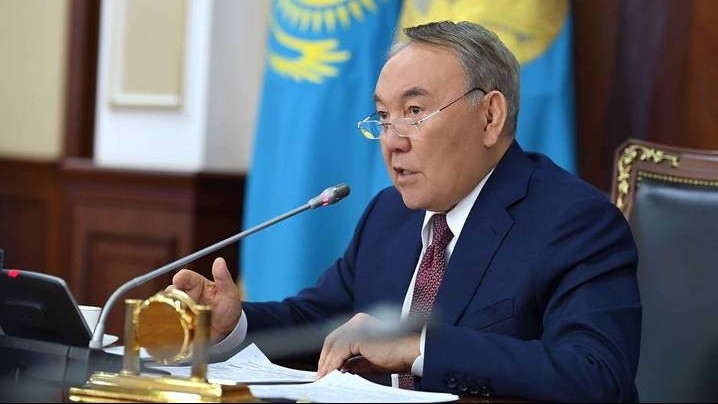
Kazakhstan’s President Nursultan Nazarbayev says the establishment of the Eurasian Economic Union (EAEU) has nothing to do with restoration of the Soviet Union.
In his new book The Era of Independence Nazarbayev, in particular, noted that “as far as those who are susceptible to irrational fears are concenred, I answered them in 2011: there will be no “restoration” or “reincarnation” of the Soviet Union. This is just phantoms of the past, allegations and speculations.”
“I have always seen the Eurasian Economic Union as an open community, organically inscribed in global economy and reliable bridge between Europe and Asia,” Kazakh leader noted in his book.
Nazarbayev also underlined a significant potential of cooperation between the Eurasian Economic Union and the European Union.
To date, that Eurasian Economic Union includes five nations: Armenia, Belarus, Kazakhstan, Kyrgyzstan and Russia.
Each of the members came into this integration unit to implement their own narrow national objectives.
Russia, for examle, is trying to create an alternative to the European Union, offering associate membership to post-Soviet countries.
Kazakhstan, which has the longest common border out of all Russia’s neighbors, wants to gain a foothold in the region as a serious political and economic player. In addition, for Astana, Russia is an attempt to find a balance against the growing influence of China.
Armenia has no land borders with any of the countries of the EAEU. Moreover, its economic and trade relations with Russia are carried out through neighboring Georgia, as its western and eastern boundaries are blocked by Turkey and Azerbaijan. Thus, Yerevan sees the EAEU solely in terms of strengthening military and political relations with Russia.
Belarus and Kyrgyzstan, meanwhile, are trying to gain economic and financial dividends from Russia and Kazakhstan for their internal needs.
A treaty aiming for the establishment of the EAEU was signed on May 29, 2014 by the leaders of Belarus, Kazakhstan and Russia, and came into force on January 1, 2015. Treaties aiming for Armenia's and Kyrgyzstan's accession to the Eurasian Economic Union were signed on October 9 and December 23, 2014, respectively. Armenia's accession treaty came into force on January 2, 2015. Kyrgyzstan's accession treaty came into effect on August 6, 2015.
The Eurasian Economic Union has an integrated single market of 183 million people and a gross domestic product of over 4 trillion U.S. dollars. The EAEU introduces the free movement of goods, capital, services and people and provides for common transport, agriculture and energy policies, with provisions for a single currency and greater integration in the future. The union operates through supranational and intergovernmental institutions. The Supreme Eurasian Economic Council is the “Supreme Body” of the Union, consisting of the Heads of the Member States. The other supranational institutions are the Eurasian Commission (the executive body), the Eurasian Intergovernmental Council (consisting of the Prime Ministers of member states) and the Court of the EEU (the judicial body).