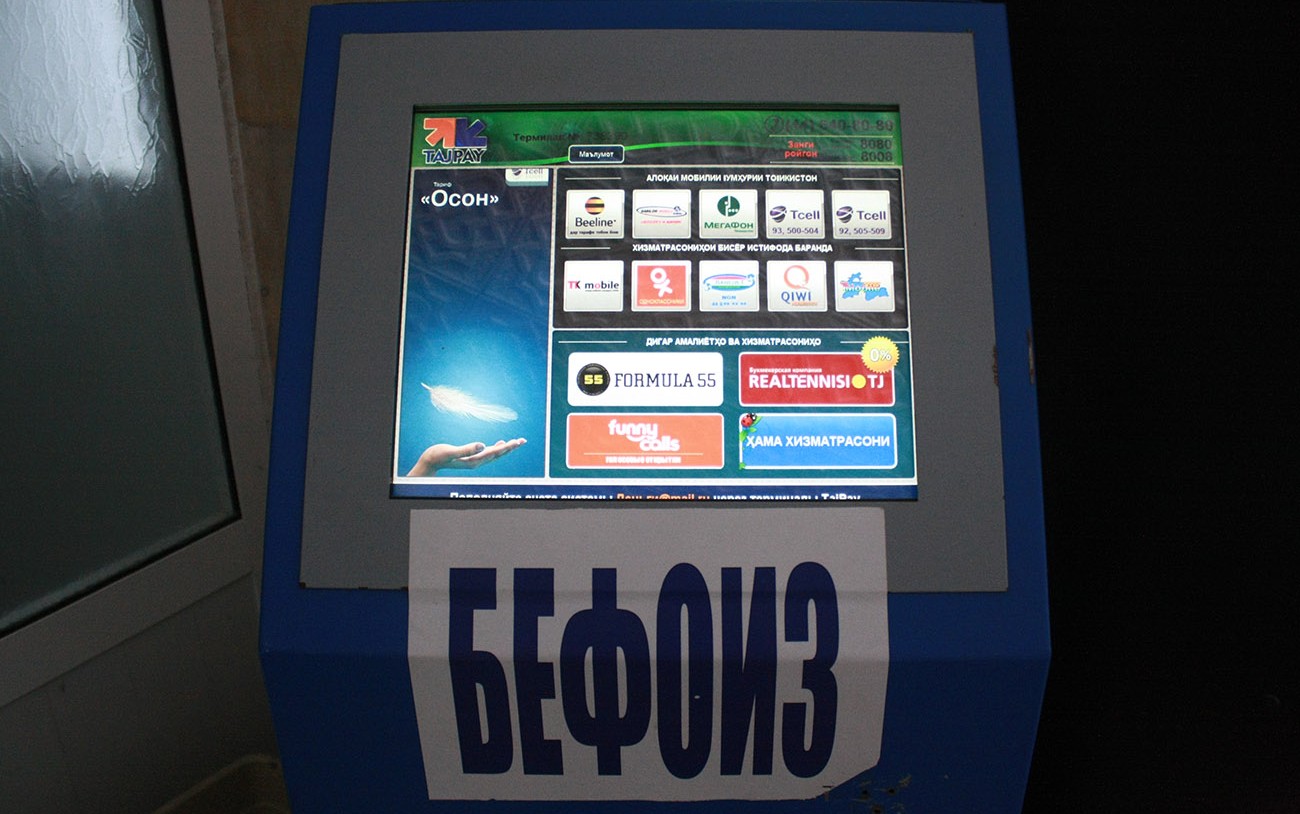
It is already the second month that shoppers in Tajikistan cannot use payment terminals to top up their e-wallet accounts. The services of e-wallet companies Qiwi and Yandex.Money are mostly used in Tajikistan.
Representatives of payment systems owing those payment terminals say the problem has resulted from changes made to the country’s payment services legislation.
It is connected with regulation of activities of payment services providers by the National Bank of Tajikistan,” a source at Tajik central bank told Asia-Plus in an interview.
According to him, this problem will be fully resolved this week.
He further noted that payment systems that had got a license from the Tajik central bank were operating without any restrictions.
The NBT promises to provide additional written on this issue in the new future.
Under the law on payment systems, commercial companies engaged in accepting payments through self-service terminals must conclude agreements with lending agencies and function as bank payment agents.
This law reportedly regulates activities of payment services providers (including those on transfer of electronic funds), bank payment agents and subagents, payment system operators, payment infrastructure services operators and sets requirements for organization of the payment system activity and the procedure of control over the payment system.
Meanwhile, EurasiaNet.org notes that the impasse has its roots in the contents of a letter written last year by the chairman of the tax committee to the president. The appeal, the contents of which were published by local media in December, essentially argued that the government needed to find new sources with which to “top up the state budget.”
One option suggested by the taxman, Nusratullo Davlatzoda, was to demand payment of taxes from multinational corporations like Google, Apple, Microsoft, Facebook, eBay, AliExpress and Yahoo. His broader point was that online commerce was robbing the local treasury of valuable revenue. When Tajik consumers buy airline tickets, books and household items or book hotels online, they only generate profit for foreign companies, Davlatzoda said.
Under a law adopted in March 2017, companies servicing cash transfers to e-wallets were required to re-register and this time to do so through domestic banks. Many of the companies duly tried to comply but were told they had failed to submit the proper documents. In February, this failure to register was cited by the National Bank as grounds to halt payments to e-wallets. Officials have said the revised rules on registration were needed to increase transparency, combat money-laundering and to prevent the financing of terrorism.
E-wallet is a type of pre-paid account in which a user can store his/her money for any future online transaction. An E-wallet is protected with a password. With the help of an E-wallet, one can make payments for groceries, online purchases, and flight tickets, among others.
E-wallet has mainly two components, software and information. The software component stores personal information and provides security and encryption of the data. The information component is a database of details provided by the user which includes their name, shipping address, payment method, amount to be paid, credit or debit card details, etc.