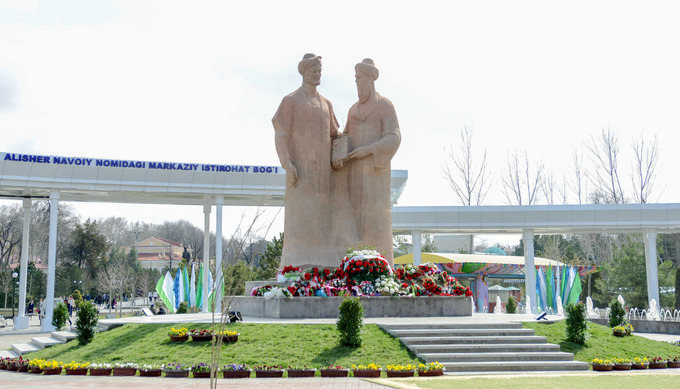
The Dushanbe mayor’s office has announced contest for the best design of monuments to Tajik poet Abdurahman Jami and Uzbek poet Alisher Navai in Dushanbe.
Both nationals of Tajikistan and foreigners may participate in the contest and its results will be announced on June 20, a source at the Dushanbe’s mayor’s office said.
Recall, Tajik President Emomai Rahmon last month ordered to erect monuments to Tajik poet Abdurahman Jami and Uzbek poet Alisher Navai in Dushanbe.
According to the Tajik president’s official website, the monuments to Jami and Navai, who had been connected by a close friendship, will be erected as a token of friendship between the Tajik and Uzbek peoples.
Besides, by president’s decree the 50-Solagii Park in Dushanbe will be renamed Alisher Navai Park.
The monuments to Jami and Navai will be erected in this park.
Nouriddin Abdurahman Jamī, also known as Mawlana Nouriddin Abdurahman or Abdurahman Nouriddin Muhammad Dashti, or simply as Jami (November 7, 1414 – November 9, 1492), was a Persian (Tajik) poet who is known for his achievements as a prolific scholar and writer of mystical Sufi literature. His most famous poetic works are Haft Awrang, Tuhfat al-Ahrar, Layla wa -Majnun, Fatihat al-Shabab, Lawa'ih, Al-Durrah al-Fakhirah.
Jami worked within the Tīmurid court of Herat helping to serve as an interpreter and communicator. His poetry reflected Persian culture and was popular through Islamic East, Central Asia and the Indian subcontinent. His poetry addressed popular ideas that led to Sufi's and non-Sufi's interest in his work. He was known not only for his poetry, but his theological works and commentary of on culture. His work was used in several schools from Samarqand to Istanbul to Khayrabad in Persia as well as in the Mughal Empire. For centuries Jami was known for his poetry and profound knowledge.
Mir Alisher Navai (February 9, 1441 – January 3, 1501), also known as Nizamuddin Alisher Herawi was a Turkic (modern-day Uzbek, Uyghur) poet, writer, politician, linguist, mystic, and painter. He was the greatest representative of Chagatai literature.
Under the pen name Navai, Alisher was among the key writers who revolutionized the literary use of the Turkic languages. Navai himself wrote primarily in the Chagatai language and produced 30 works over a period of 30 years, during which Chagatai became accepted as a prestigious and well-respected literary language. Navai also wrote in Persian (under the pen name Fani), and, to a much lesser degree, in Arabic.