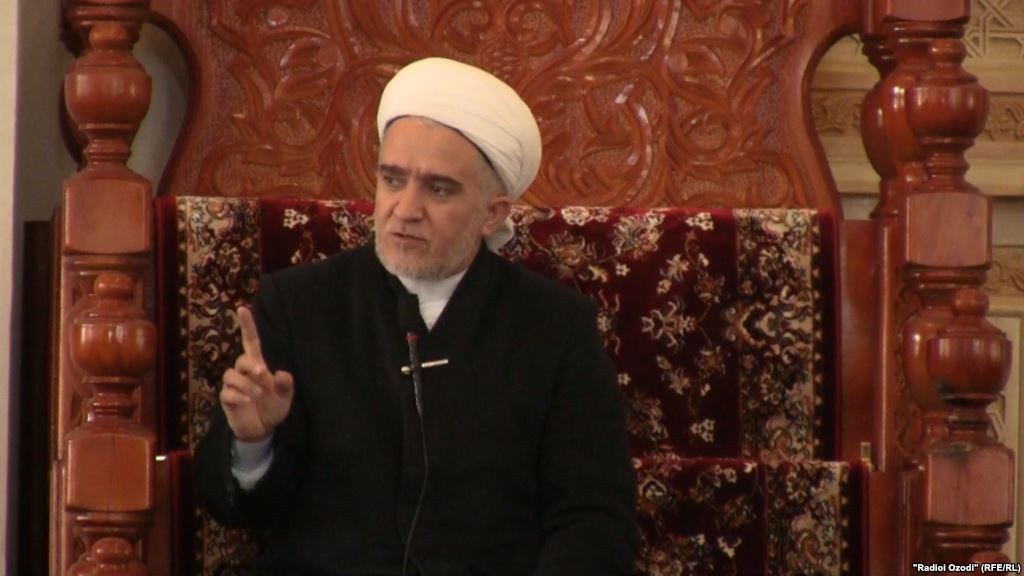
The Shuroi Ulamo (Council of Ulamo — an Islamic council that issues fatwas (religious rulings) and religious guidance to Islamic religious organizations) of Tajikistan has accused Iran of provocations.
A statement by the Shuroi Ulamo that was posted on the Committee on Religious Affairs (CRA)’s official website on May 23, in particular, notes that Iran allegedly had a hand in further destabilization of the situation in war-torn countries such as Afghanistan, Iraq, Syria and Yemen.
Iran reportedly now once again seeks to aggravate the situation in Tajikistan with help of some provokers.
“We know one thing: if Iran feels the slightest benefit, it will play a role in destabilization of any region, laying the blame for that on enemies of Islam and Muslims,” says the statement.
Recall, some 50 people gathered outside the Iranian Embassy in Dushanbe on May 21 to protest Tehran's alleged support for the banned Islamic Revival Party of Tajikistan (IRPT). Those gathered, mostly young people, were carrying signs saying, “Down with Kabiri” and "We don't want to relive the events of 1992-2000", “What do you want from the people of Tajikistan?”; and “Return our children”.
The protest meeting reportedly lasted for not more than half an hour and those gathered then dispersed.
The statement by the Shuroi Ulamo and the protest rally outside the Iranian Embassy were preceded by a public meeting that took place in Dushanbe on May 12. Speaking at that meeting, Tajik President Emomali Rahmon once again dusted off long-standing accusations that Iran had abetted the armed opposition during the civil war of the 1990s.
Tajikistan and Iran have traditionally close relations, sharing many similar cultural, religious and ethnic identifiers and Iran has been a major sponsor of essential hydropower infrastructure in Tajikistan, but Iran has angered Tajikistan by welcoming the Islamic Revival Party (IRPT) leader Muhiddin Kabiri, who is wanted by police in Tajikistan to face various terrorism charges.
Recall, Iran invited IRPT leader Muhiddin Kabiri to attend the International Islamic Unity Conference that took place in Tehran on December 27-29, 2015.
Tajikistan’s MFA said in a statement on December 29, 2015 that it was “greatly concerned” that “the head of the extremist and terrorist former IRPT, Muhiddin Kabiri, who faces charges of attempting to overthrow the government … has been invited to the conference.”
In April 2016, Tajikistan’s customs service introduced restrictions on the import of food products from Iran. Dry leaf tea, poultry and other goods were ruled unacceptable for their allegedly poor quality. In July 2016, the Tajik office of Iran’s Khomeini Imdod Committee, an international development fund, closed. In early July this year, the Iranian trade and culture center in the Tajik northern city of Khujand, which was particularly appreciated for its library services and fast internet, closed its doors. The shuttering reportedly came at the request of the Tajik authorities.
In August 2017, Tajik authorities have accused Iran of backing high-profile killings in Tajikistan during the Tajik civil war in the 1990s. In a documentary broadcast on Tajik national television on August 8, the Interior Ministry of Tajikistan claimed that Iran was allegedly interested in unleashing civil war in Tajikistan, and it allegedly provided assistance to the Islamic Revival Party of Tajikistan and trained its militants in Iranian territory. The documentary also accused Iran of involvement in the murder of several Tajik social and political figures as well as 20 Russian military officers in the country during the 1990s Tajik civil war. The documentary further claimed that at the time, Iran had organized a plot to “eliminate Tajik scientists and intellectuals.
Iran’s Embassy in Dushanbe on August 9, 2017 released a statement, in which it dismisses “unfounded claims made in the documentary.” The statement posted on the Embassy’s website, in particular, described such claims as 'regrettable' saying there is no doubt that the documentary’s producers will not be able to mar cultural bonds and historic friendship between the two nations of Iran and Tajikistan.
It added that the noble nation of Tajikistan will never forget that Iran as one of the main founders and guarantors of Tajikistan’s peace and host of talks between the country's conflicting sides, has played a constructive role in ending Tajikistan's civil wars in 1990.