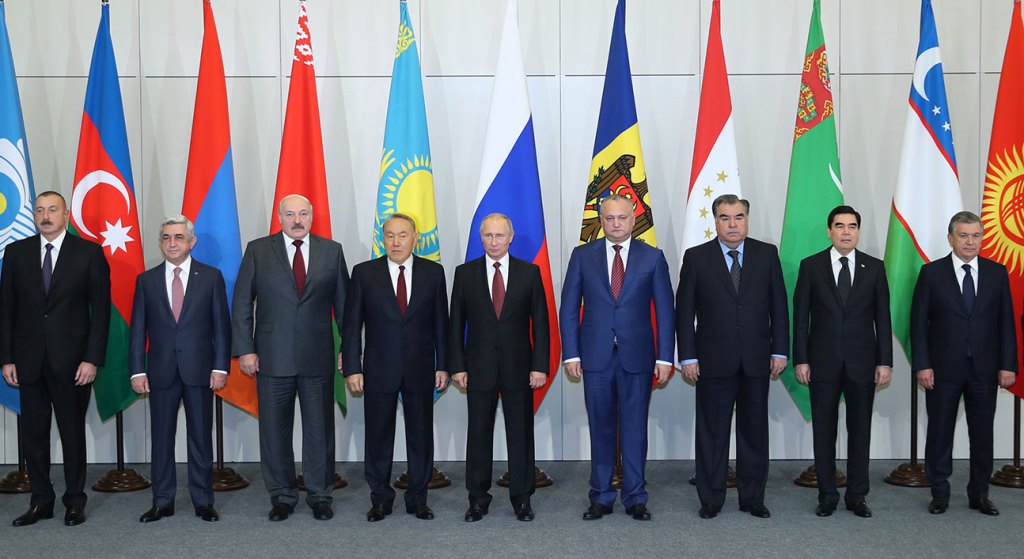
The 28th session of the CIS Council of Heads of State that will take place in Dushanbe on September 28 is expected to discuss crime prevention measures.
In all, sixteen issues related to political, economic, security and humanitarian cooperation between the CIS member nations have been tabled to the session’s agenda, according to the CIS Executive Committee’s website.
Four issues will be dedicated to measures to provide security within the CIS area.
One of the most important documents in this sphere is the interstate program of joint measures to combat crime in the CIS designed for 2019-2023.
The Bureau for the Coordination of Efforts to Combat the Organized Crime and Other Dangerous Types of Crime in the Territory of the CIS Countries has worked out this document and the CIS Council of Foreign Ministers endorsed it in April this year.
The program includes measures to combat cross-border crime, trafficking in drugs and human beings, illegal migration and cybercrimes.
Recall, Tajikistan took over the CIS chairmanship from Russia in October 2017 in Sochi, Russia. Speaking at the CIS summit, President Emomali Rahmon outlined priorities of Tajikistan’s chairmanship, including fight against terrorism, road and railway connections, cooperation in use of renewable energy sources.
Turkmenistan will assume the rotating CIS chairmanship and Ashgabat will host the next annual CIS summit.
Established on December 8, 1991 after the dissolution of the Soviet Union, the Commonwealth of Independent States (CIS) is a regional organization. It now consists of Azerbaijan, Armenia, Belarus, Kazakhstan, Kyrgyzstan, Moldova, Russia, Tajikistan, Turkmenistan, Uzbekistan and Ukraine. Georgia pulled out of the organization in 2009.
Although Ukraine was one of the founding countries and ratified the Creation Agreement in December 1991, Ukraine chose not to ratify the CIS Charter as it disagrees with Russia being the only legal successor state to the Soviet Union. Thus it does not regard itself as a member of the CIS. In 1993, Ukraine became an "Associate Member" of CIS. On March 14, 2014, a bill was introduced to Ukraine's parliament to denounce their ratification of the 1991 Agreement Establishing the CIS, following the Russian military intervention in Ukraine and annexation of Crimea, but was never approved. Following the 2014 parliamentary election, a new bill to denounce the CIS agreement was introduced. In September 2015, the Ukrainian Ministry of Foreign Affairs confirmed Ukraine will continue taking part in CIS “on a selective basis.” Since that month, Ukraine has had no representatives in the CIS Executive Committee building. In April 2018, Ukrainian President Petro Poroshenko indicated that Ukraine would formally leave the CIS. On May 19, 2018, President Poroshenko signed a decree formally ending Ukraine's participation in CIS statutory bodies. However, as of 1 June the CIS secretariat had not received formal notice from Ukraine of its withdrawal from the CIS, a process which will take 1 year following notice being given. Ukraine has stated that intends review its participation in all CIS agreements, and only continue in those that are in its interests. In early August this year, Ukraine shut down its representative office at the CIS statutory bodies. CIS Executive Secretary Sergei Lebedev said on August 28 that the grouping's ties with Kyiv are now being maintained through the Ukrainian Embassy in Minsk.