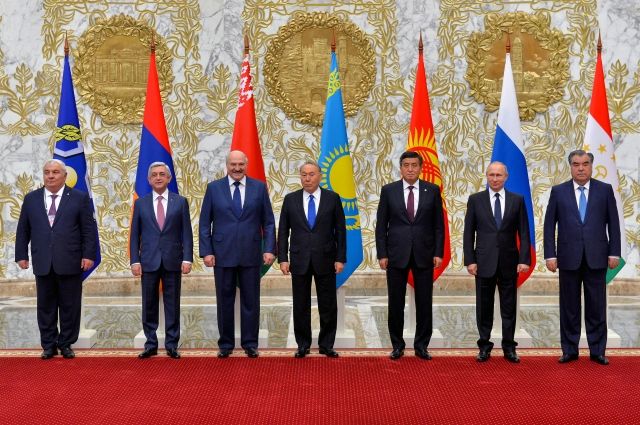
A summit of the Collective Security Treaty Organization (CSTO) that took place in the Kazakh capital of Astana on November 8 has adopted a final declaration and a statement by the heads of CSTO member states on taking concerted measures against individuals who participated in armed conflicts on the side of international terrorist organizations.
The summit brought together the presidents of Belarus, Kyrgyzstan, Kazakhstan, Tajikistan and Russia. Armenia was represented by acting Prime Minister Nikol Pashinyan.
The CSTO Collective Security Council session’s agenda included issues of international and regional security, coordination of foreign policy activities of the CSTO member states, improving mechanisms for counteracting threats and challenges and the development of the CSTO military capabilities, according to the Tajik president’s official website.
The heads of state discussed a number of issues in private. Other agenda items were considered during a plenary meeting that was attended by foreign ministers, defense ministers and Secretaries of the Security Councils of the CSTO member states and also CSTO Acting Secretary General Valery Semerikov,
In all, some twenty issues were discussed at the meeting, including a plan of action to develop a coordinated information policy in the interests of the CSTO member states and a plan to develop a collective system to counter illegal migration through 2025.
Speaking at the summit, Tajik President Emomali Rahmon pointed to the necessity of more integration of the CSTO member nations in addressing modern challenges and threats.
Tajik leader, in particular, expressed concern about increase in drug trafficking and the difficult military and political situation in Afghanistan.
In this connection, Rahmon drew attention of heads of the CSTO member nations to the issues related to reinforcing Tajikistan’s common border with Afghanistan and the process of further implementation of the Collective Security Council decision on providing assistance to Tajikistan to reinforce its national border with Afghanistan and implementation of the targeted interstate program on reinforcing Tajikistan-Afghanistan border.
Members of the CSTO Collective Security Council also discussed the issue of appointment of a new secretary-general of the Organization after Armenia recalled its representative. The sides reportedly agreed to continue discussions on the issue during a meeting in St. Petersburg on December 6.
In 2018-2019 Kyrgyzstan will preside in the CSTO. The president of Kyrgyzstan announced his country's priorities for the period of the presidency in the organization.
Ahead of the CSTO summit, Astana hosted joint sessions of the Organization’s Council of Foreign ministers, Council of Defense Ministers and Committee of Security Council Secretaries.
The regional security organization was initially formed in 1992 for a five-year period by the members of the CIS Collective Security Treaty (CST) — Armenia, Kazakhstan, Kyrgyzstan, Russia, Tajikistan, and Uzbekistan, which were joined by Azerbaijan, Georgia, and Belarus the following year. A 1994 treaty reaffirmed the desire of all participating states to abstain from the use or threat of force, and prevented signatories from joining any “other military alliances or other groups of states” directed against members states. The CST was then extended for another five-year term in April 1999, and was signed by the presidents of Armenia, Belarus, Kazakhstan, Kyrgyzstan, Russia, and Tajikistan. In October 2002, the group was renamed as the CSTO. Uzbekistan that suspended its membership in 1999 returned to the CSTO again in 2006 after it came under international criticism for its brutal crackdown of antigovernment demonstrations in the eastern city of Andijon in May 2005. On June 28, 2012, Uzbekistan announced that it has suspended its membership of the CSTO, saying the organization ignores Uzbekistan and does not consider its views. The CSTO is currently an observer organization at the United Nations General Assembly.