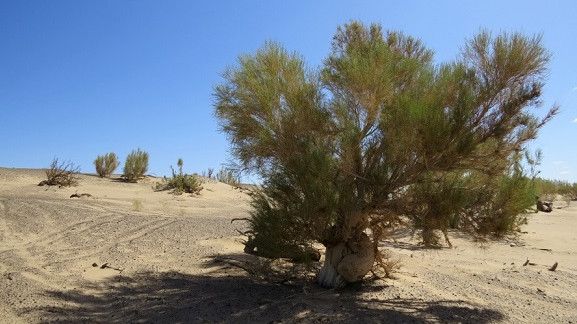
Uzbekistan plans to transform the Aral Sea’s dead zone into a forest

Citing Uzbekistan’s Ministry of Justice, Russia’s RIA Novosti reports Uzbekistan plans to plant some 500,000 hectares of the Aral Sea’s dead zone with trees in an effort to promote the ecological recovery of the region.   According to RIA Novosti, the Uzbekistan’s authorities plan to allocate 100 billion sum (equivalent to 12 million U.S. dollars) for […]

Asia-Plus

Citing Uzbekistan’s Ministry of Justice, Russia’s RIA Novosti reports Uzbekistan plans to plant some 500,000 hectares of the Aral Sea’s dead zone with trees in an effort to promote the ecological recovery of the region.  

According to RIA Novosti, the Uzbekistan’s authorities plan to allocate 100 billion sum (equivalent to 12 million U.S. dollars) for these purposes.  

The loss of water has caused many major problems.  A new desert called Aralkum has arisen that already has consumed more than 5.5 million hectares of arable land.

The Aral is an inland sea between Kazakhstan and Uzbekistan, to the east of the Caspian Sea. At one time, it was the world's fourth-largest inland body of water — after the Caspian Sea between Europe and Asia, Lake Superior in North America and Lake Victoria in Africa.

The Aral Sea started to shrink in the 1960s when the Soviets diverted water from the two main rivers that flowed into the Aral Sea to feed vast new cotton fields.

As the volume of water decreased, the concentration of salt increased, poisoning everything in the sea.

The Aral Sea has reportedly shrunk to 10% of its former size – an area of water as big as Ireland has been lost.  The loss of the Aral Sea in Central Asia is an ecological disaster. 

Join us on social media!

Article translations:

Related Article

Оби зулол
Оби зулол

Most Read

Акика Алиф

Recent Articles

In Tajikistan, the workforce has increased, but not everyone is employed

Statistics show a significant gap between men and women in the labor market.

Amin Qobilov and Marvori Nasriddinzoda become chess champions of Tajikistan

The national chess tournament, which brought together the strongest players, has concluded in Dushanbe.

How to tame snow avalanches: how many houses and roads in Tajikistan are at risk?

Large avalanches can occur on average once every 40 years, causing residents to eventually consider dangerous areas safe and build houses on them.

Emomali Nourali and Muhiddin Asadulloyev became No. 1: Tajik judokas in the world ranking

After the "Grand Slam" in Dushanbe, the IJF ranking was updated, recording a historic result.

Media: the US struck Iranian ports but denies resuming war

Iran's military opened fire on forces that attempted to attack a pier on Qeshm Island.

Uzbekistan implements digital residency registration system

It will be possible to process it online through Face-ID.