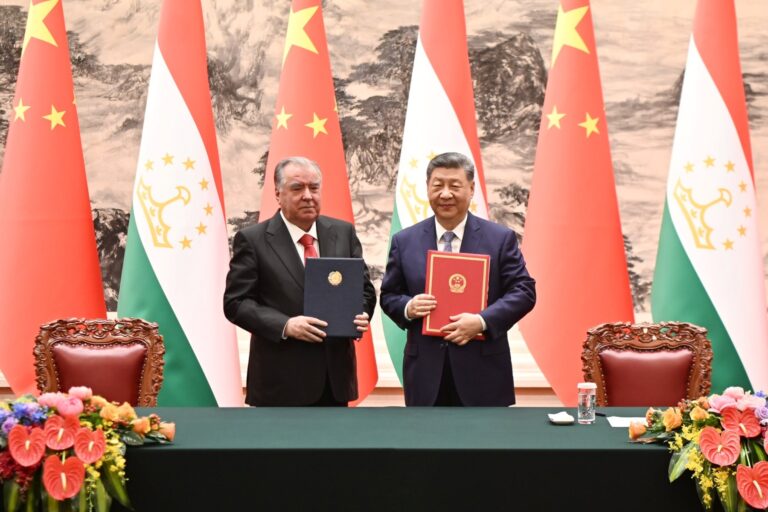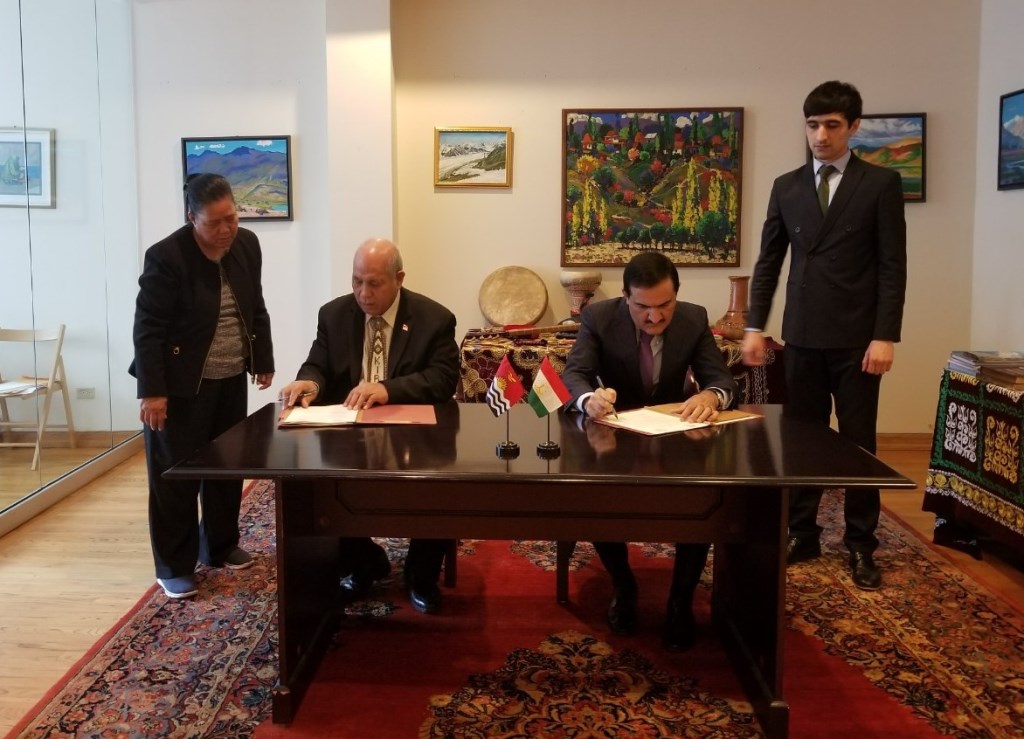
Tajikistan has established diplomatic relations with the Republic of Kiribati. A ceremony of signing of a joint statement on establishment of diplomatic relations between the two countries has been signed in New York.
The document was inked by Mr. Mahmadamin Mahmadaminov, Permanent Representative of Tajikistan to the United Nations, and Mr. Teburoro Tito, Permanent Representative of the Republic of Kiribati to the United Nations, on April 5, 2019, according to the Tajik MFA information department.
Kiribati, officially the Republic of Kiribati, is a sovereign state in Micronesia in the central Pacific Ocean. The state comprises 32 atolls and reef islands and one raised coral island, Banaba. They have a total land area of 800 square kilometers and are dispersed over 3.5 million square kilometer.
Kiribati became independent from the United Kingdom in 1979. The capital, South Tarawa, which is now the most populated area, consists of a number of islets, connected by a series of causeways. These comprise about half the area of Tarawa Atoll.
Kiribati is a member of the Pacific Community (SPC), Commonwealth of Nations, the IMF, and the World Bank, and became a full member of the United Nations in 1999
Kiribati has few natural resources. Commercially viable phosphate deposits on Banaba were exhausted at the time of independence. Copra and fish now represent the bulk of production and exports. Kiribati is considered one of the least developed countries in the world.
In one form or another, Kiribati gets a large portion of its income from abroad. Examples include fishing licenses, development assistance, worker remittances, and tourism. Given Kiribati's limited domestic production ability, it must import nearly all of its essential foodstuffs and manufactured items; it depends on these external sources of income for financing. The economy of Kiribati benefits from international development assistance programs.