Government discusses development of programs for socioeconomic development of regions

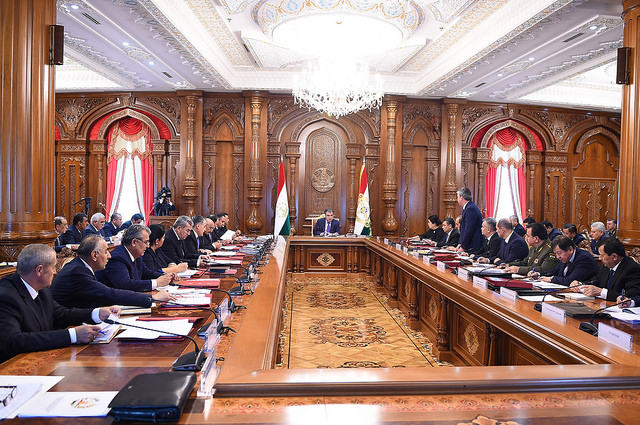
A government session, presided over by President Emomali Rahmon, was held on April 30. According to the Tajik president’s official website, the Minister of Economic Development and Trade, Nematullo Hikmatullozoda, reported on the procedure of development of programs for socioeconomic development of regions.   The minister noted that the procedure is based on modern effective public […]

Asia-Plus

A government session, presided over by President Emomali Rahmon, was held on April 30.

According to the Tajik president’s official website, the Minister of Economic Development and Trade, Nematullo Hikmatullozoda, reported on the procedure of development of programs for socioeconomic development of regions.  

The minister noted that the procedure is based on modern effective public management methods and takes into account specifics, potential, priorities and resources of cites and districts.  

To bring the process of development of the programs into a single system, the head of state reportedly ordered to take into consideration objectives and priorities of strategic documents, particularly the National Development Strategy of the Republic of Tajikistan for the period to 2030 (NDS-2030). 

The session also heard information about bills requiring amendments to the country’s laws on military intelligence service of the Armed Forces of Tajikistan and other mandatory payments to the budget as well as to the country’s criminal, administrative, tax and customs codes.  

The bills were sent for consideration to the Majlisi Namoyandagon (Tajikistan’s lower chamber of parliament). 

Recall, the main priorities of the NDS-2030 include: 1) education; 2) health care; 3) employment; 4) inequality; 5) combating corruption; 6) food security and nutrition; 7) good governance; 8) social welfare; 9) prevention of potential conflicts; and 10) energy security, environmental protection and management of demographic processes.

NDS-2030 suggests that coordination institutions and accountability of state administration bodies, business and civil society should play an important role for the implementation of these priorities.  Performance of these institutions will be based on a national system of evaluation and forecasting of future development, short-term and long-term objectives and plans for implementation, accordingly.

Article translations:

Related Articles

Оби зулол

Most Read

Join us on social media!

Recent Articles

Hajj 2026: New Rules and Restrictions Introduced in Saudi Arabia

Entry to Mecca is now only possible with a special permit.

Emomali Rahmon flies to Astana for the Regional Ecological Summit

President of Tajikistan Emomali Rahmon departed today for a...

Nexign and TelecomDaily: the telecommunications market in Tajikistan grew by 13.7% in 2025

A study showed that the country's communications market has grown to 4.9 billion somoni, and the dynamics are influenced by an increase in the subscriber base, growth in internet traffic, and expansion of mobile and fixed network coverage.

Tajikistan’s Parliament approves organized recruitment of migrants to Russia

The paperwork will be transferred to the home country, and employers will select employees in advance.

Creativity as an asset: why marketing in Central Asia is reaching a new level

Business expert in international projects for the support and development of media companies, Svetlana Lebedeva, on marketing and the media market.

European Immunization Week starts in Tajikistan

Information and awareness-raising activities are being conducted across the country to increase trust in vaccination and combat misinformation.

The plan to launch the CASA-1000 project in 2027 discussed in Dushanbe

The Ministry of Energy of Tajikistan, Afghan DABS, and other project participants held a series of meetings.