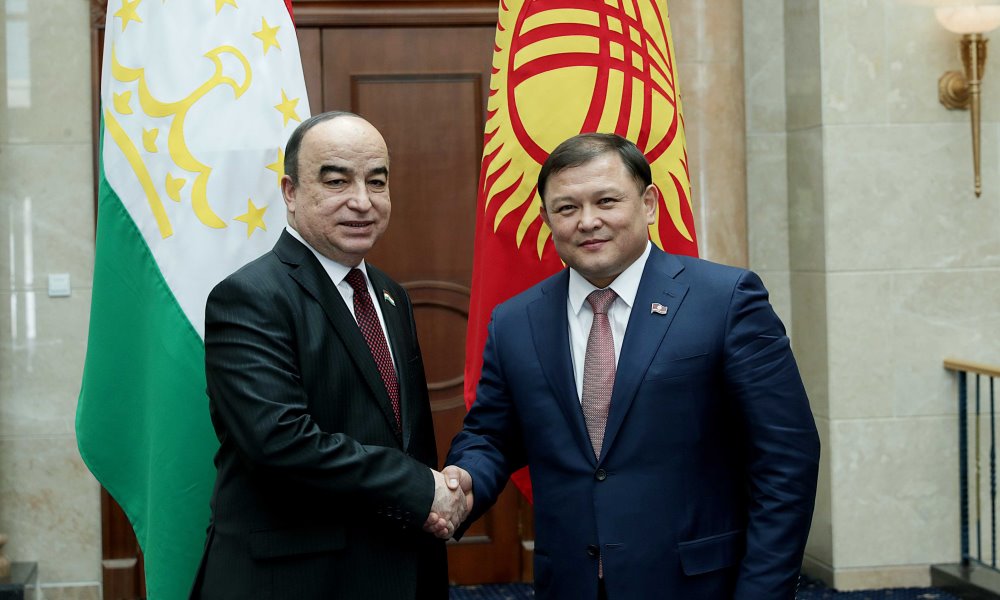
Chairman of Tajikistan’s lower house (Majlisi Namoyandagon) of Parliament (Majlisi Oli), Shukurjon Zuhurov, met with Dastanbek Jumabekov, Chairman of Jogorku Kenesh (Kyrgyzstan’s unicameral Parliament), in the Kyrgyz capital, Bishkek, on May 20.
According to the press center of Kyrgyzstan’s Parliament, the two sides discussed ways to solve border issues.
Tajik parliament speaker, in particular, noted that all border issue could be solved though diplomacy.
Jumabekov, for his part, noted that it was necessary to build confidence with the peoples and continue work on providing security and stability in border areas.
Zuhurov and Jumabekov expressed confidence that active interaction between parliamentary friendship groups would promote expansion of inter-parliamentary cooperation between the two countries.
The meeting reportedly took place on the sidelines of a visiting session of the Council of the Parliamentary Assembly of the Collective Security Treaty Organization (PA CSTO) that took place in Bishkek on the same day.
According to Kyrgyz media reports, speaking at the session, Dastanbek Jumabekov outlined the priorities of Kyrgyzstan’s chairmanship in the Collective Security Treaty Organization in 2019.
Chairman of the PA CSTO, Vyacheslav Volodin, who is Chairman of the State Duma (Russia’s lower chamber of parliament), noted the positive result of the practice of the visiting session of the CSTO PA Council.
Executive Secretary of the CSTO PA, Pyotr Ryabukhin, presented information on the CSTO PA work plans of the for 2019.
The members of the Council of the Parliamentary Assembly of the Collective Security Treaty Organization approved Vice Speaker of the Armenian Parliament Alain Simonyan as Chairman of the PA CSTO Standing Committee on Political Affairs and International Cooperation and State Duma Deputy Speaker Dmitry Novikov as Deputy Chairman of the PA CSTO Standing Committee on Political Affairs and International Cooperation.
The Bishkek meeting was attended by the delegations of the CSTO PA member countries: Russia, Kazakhstan, Tajikistan, Belarus, Armenia. Representatives of the Republic of Serbia and the Islamic Republic of Afghanistan attended the session as observers.
The next session of the Council and the 12th plenary meeting of the PA CSTO will take place in Yerevan, Armenia in the autumn of 2019.
The PA CSTO is responsible for inter-parliamentary interaction of the IPA CIS members who are also members of the Collective Security Treaty Organization (CSTO). The PA CSTO was established by a resolution On Measures for Creating a Parliamentary Dimension of the Collective Security Treaty Organization at the CIS Inter-Parliamentary Assembly, which was adopted on November 16, 2006 to address the priority goals of the development of the CSTO legal framework within the IPA CIS.
The PA CSTO comprises parliamentary delegations from Armenia, Belarus, Kazakhstan, Kyrgyzstan, Russia and Tajikistan. The PA CSTO Chair and the PA CSTO Council of the heads of parliament (parliament houses) oversee the operation of the PA CSTO. The rotating position of the PA CSTO Chair is held for a period of three years.
The PA CSTO has three standing commissions on defense and security; on political affairs and international cooperation; and on socioeconomic and legal affairs. The PA CSTO Council has a Working Group on the Standardization and Coordination of the CSTO Member States’ Legislations and the Expert Advisory Council. The Information and Analysis Center operates under the PA CSTO.
The documents regulating the activities of the PA CSTO bodies include Regulations of the Council of the CSTO Parliamentary Assembly; Regulations on the Standing Commissions of the CSTO Parliamentary Assembly; Regulations on the Expert Advisory Council at the Council of the CSTO Parliamentary Assembly; Regulations on the Information and Analysis Centre of the CSTO Parliamentary Assembly; and Regulations on the Secretariat of the CSTO Parliamentary Assembly.