United Nations Development Programme (UNDP) yesterday handed over hydraulic search and rescue equipment to the Committee of Emergency Situations and Civil Defense under the Government of the of Tajikistan (CoES), according to UNDP Country Office in Tajikistan.
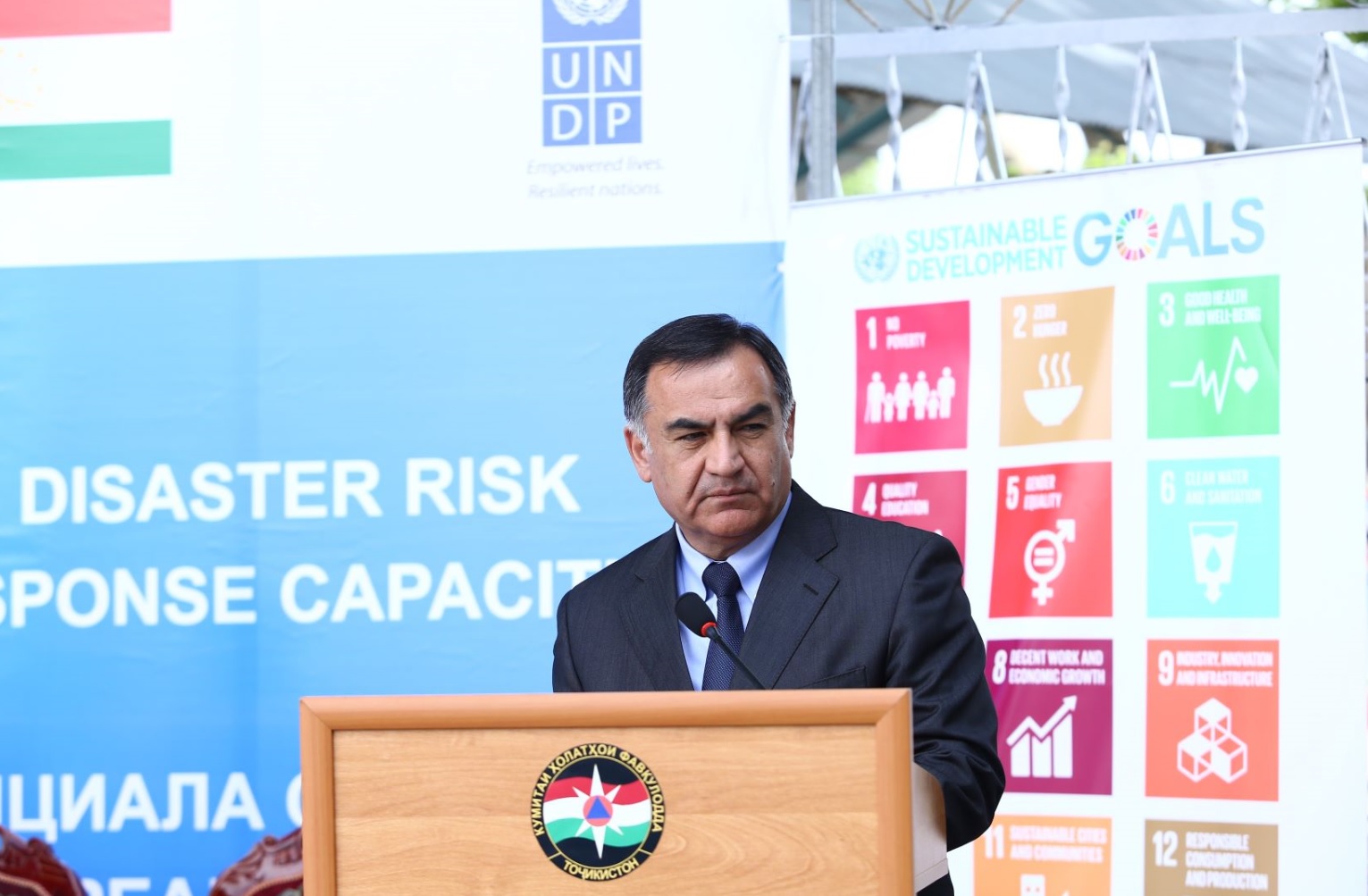
“All the efforts made to strengthen our cooperation will be directed at reducing disaster risk. Our goal is to provide help [not only] to the citizens of our country, but also to the people of other countries,” Chairman of the Emergencies Committee, Rustam Nazarzoda said in his speech at the handover ceremony.
Aimed at strengthening rescue teams’ capacity for emergency response, the equipment will be used for search and rescue activities during natural disasters, as well as individual cases.
According to CoES data, non-compliance to safety rules is a common cause for emergency in Tajikistan: In 2018 alone hundreds of people fell victim to car accidents in Tajikistan as safety rules were ignored.
The rescue gear was provided within UNDP’s Strengthening Disaster Risk Reduction and Response Capacities project funded by the people of Japan. The project aims to improve collection and use of risk information, local land use, disaster preparedness and response, weather forecasting, and build search and rescue capacity.
Mr. Hajime Kitaoka, Ambassador Extraordinary and Plenipotentiary of Japan to Tajikistan, underlined that reinforcing the teams technologically is only one part of the joint efforts to bolster resistance that needs to be significantly backed up by personnel trainings.
“I have always been emphasizing the importance of training people in coping with disasters, because the training of the local people is more important than the introduction of equipment. Only after the disasters, the introduction of equipment is useful for rescue operations or recovery operations,” he said adding “Our final goal must be to save as many lives as possible.”
In 2016, UNDP signed three new project documents with CoES and corresponding funding schemes agreed with the Government of Japan, the Russian Federation-UNDP Trust Fund for Development and the Swiss Agency for Development and Cooperation for the implementation of projects to strengthen disaster risk reduction, preparedness and response capacities, as well as disaster risk governance in Tajikistan.
“Today we are handing over the equipment to CoES, which will strengthen the capacity of search and rescue teams, but I hope that we will also continue working towards establishing coordinated mechanism in this sphere,” said Dr. Pratibha Mehta, UNDP Resident Representative, highlighting the importance of strengthening Disaster Risk Management in Tajikistan.
UNDP partners with people at all levels of society to help build nations that can withstand crisis, and drive and sustain the kind of growth that improves the quality of life for everyone. On the ground in 177 countries and territories, it offers global perspective and local insight to help empower lives and build resilient nations.