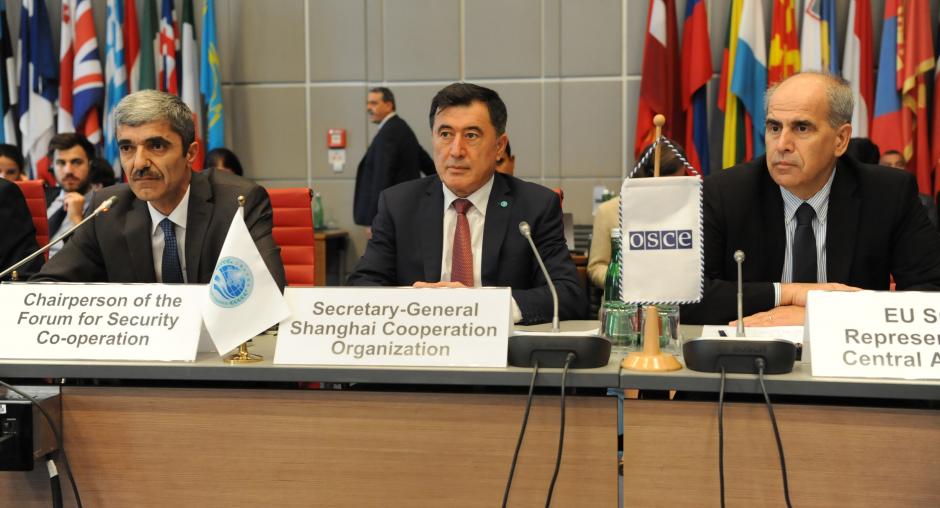
A plenary meeting of the OSCE Forum for Security Cooperation was held under the Tajikistan Chairmanship in Vienna on July 10. The meeting focused on the synergies and cooperation among the Shanghai Cooperation Organization (SCO), the European Union (EU) and the OSCE in Central Asia, according to the Tajik MFA information department.
The Tajik Chairmanship has invited Mr. Vladimir Norov, the SCO Secretary-General, Mr. Peter Burian, the EU Special Representative for Central Asia and Mr. Thomas Greminger, the OSCE Secretary-General as the keynote speakers of the plenary meeting.
The meeting provided a platform for senior officials of the three regional organizations to share their views on possibilities for candid and constructive cooperation, as well as on shared commitments to strengthen fighting transnational and emerging threats, to foster early warning, to take action, and to explore opportunities for closer co-operation on operational issues, in a demonstration of what the UN Secretary-General has termed “network multilateralism”.
In his presentation, Mr. Norov, the SCO Secretary-General reportedly presented information on cooperation between the Organization’s Member States in providing security and countering the "three forces of evil" – terrorism, extremism and separatism. He noted that since its inception the SCO has been called upon to play an important role in ensuring peace and stability in Central Asia. He highlighted the already close cooperation between his organization and the OSCE, stating that five SCO Member States are OSCE participating States. Mr. Norov said the organizations should work together in the field of countering new challenges, threats and sustainable development not only in Central Asia and Afghanistan, but also in the vast Eurasian space. He added that his Organization was currently working on a draft concept for the establishment of an SCO Anti-Drug Center in Dushanbe.
Mr. Burian, the EU Special Representative particularly noted the positive trend of intensive partnership between the EU and the countries of Central Asia in the recent years. He drew the attention of delegations to the provisions of the new EU Strategy on Central Asia of June 17, 2019 and the results of the 15th EU – CA ministerial meeting held on July 7, 2019 in Bishkek.
OSCE Secretary General Thomas Greminger opened his presentation by noting that positive regional dynamics and greater openness to regional and international cooperation in Central Asia present new opportunities for engagement. Leveraging partnerships must be a centerpiece of regional organizations’ collective response to this encouraging trend, he said.
Mr. Greminger thanked Tajikistan for inclusion of the issue of cooperation and synergy among the regional organizations in the FSC Program.
Tajikistan holds the chairmanship of the OSCE Forum for Security Cooperation (FSC) from May to August 2019.
The Forum for Security Co-operation is one of the OSCE’s two main regular decision-making bodies. Leaders at the 1992 Helsinki Summit of the Conference for Security and Cooperation in Europe – the OSCE’s predecessor – established the Forum for Security and Co-operation to strengthen the focus on politico-military security by providing for negotiations and consultations on military security and stability in the OCSE area.
The Forum provides a unique platform for the 57 OSCE participating States to discuss topical security challenges on an equal footing. The agenda for the weekly Forum meetings in Vienna always includes security dialogue, allowing participating States to raise and discuss security concerns and challenges. These discussions regularly lead to initiatives and measures to strengthen politico-military security.
The Forum Chairmanship rotates among the OSCE participating States, with each State holding the FSC Chairmanship for four months. A so-called Troika, comprising the former, present and incoming Chairmanships, ensures continuity in the Forum’s work. The Forum approves documents and decisions by consensus. The OSCE Secretariat’s FSC Support Section supports participating States’ efforts to implement FSC commitments, which – like all OSCE commitments – are politically binding.