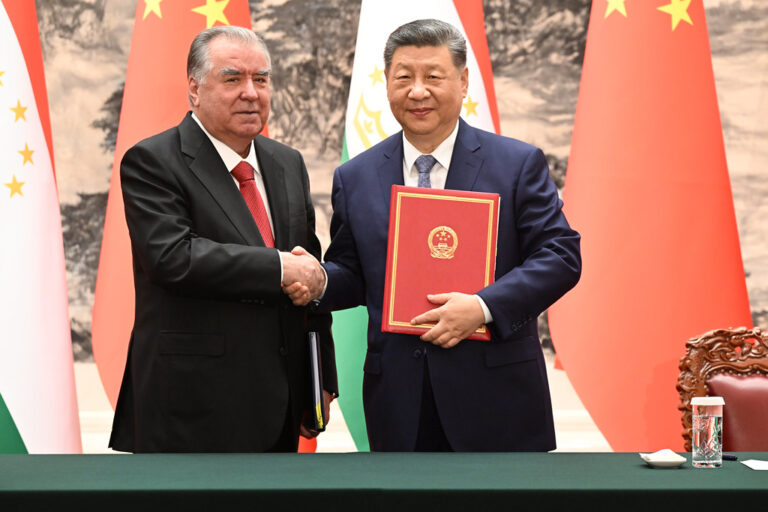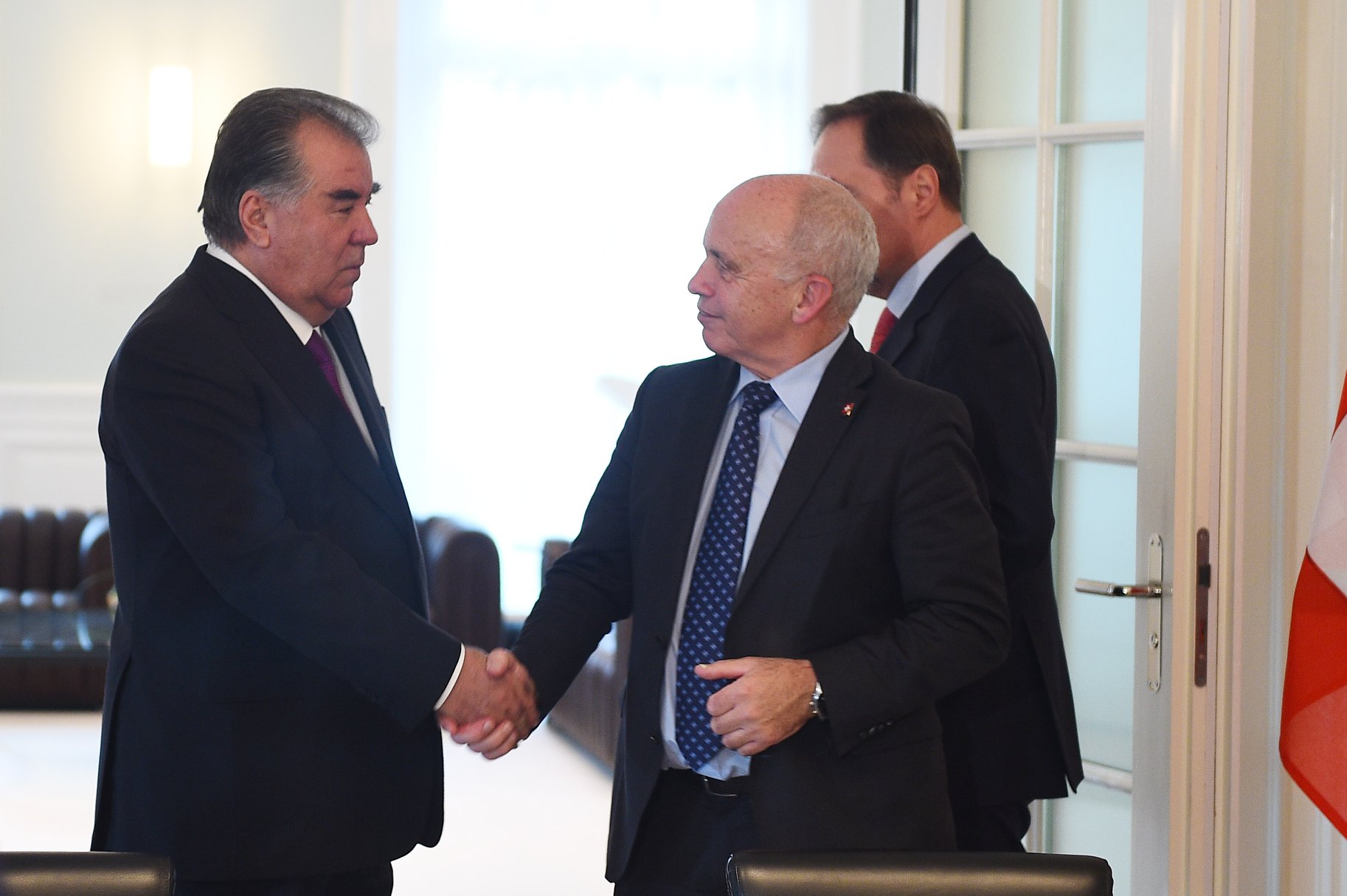
On Tuesday November 5, Tajik President Emomali Rahmon met in Bern with the President of the Swiss Confederation Ueli Maurer.
According to the Tajik president’s official website, the two heads of state discussed the current state and prospects of further expansion of bilateral cooperation between Tajikistan and Switzerland.
In the course of the talks, it was noted that the regular high-level political dialogue is an important factor in promoting effective cooperation between the parties in all areas of mutual interest. Active use of inter-parliamentary ties and establishment of Parliamentary Friendship Group for cooperation between Tajikistan and National Council of Switzerland and strengthening the legal base of interstate relations are among other important measures for the development and expansion of bilateral cooperation.
Issues related to boosting economic and trade cooperation, investment and tourism were also discussed at the meeting. Sectors like hydropower, mining, food and light industries, processing of agricultural products, transportation and communications as well as tourism were outlined as areas that could drive the bilateral cooperation between the two countries.
Tajikistan and Switzerland already have good experience in establishing mutually beneficial business cooperation. Over the first nine months of this year, the two-way trade between Tajikistan and Switzerland has reportedly valued at $132 million.
The Presidents called for intensification of the activity of the Tajik – Swiss Intergovernmental Commission on Economic Cooperation and reaffirmed the commitment to further development of the mutually beneficial cooperation, including within the framework of the Bretton Woods institutions (International Monetary Fund and World Bank), the Swiss Economic Cooperation and Development (SECO).
In the course of the talks, Rahmon and Maurer also exchanged views on cooperation in combating terrorism, radicalism, drug trafficking and other forms of transnational organized crime.
President Rahmon extended his invitation to visit Tajikistan to President Maurer, which was accepted with appreciation.
Following the talks the following new cooperation documents were signed in the presence of both state leaders:
– MoU on Cooperation between the Government of the Republic of Tajikistan and the Federal Council of Switzerland in the field of Climate Change, Disaster Risk Reduction and sustainable planning in the Republic of Tajikistan;
– MoU on Cooperation between the Government of the Republic of Tajikistan and the Federal Council of Switzerland in the field of Integrated Water Resources Management (IWRM) in the Republic of Tajikistan.
Meanwhile, Swiss government’s portal says the official talks in the Bernerhof focused on bilateral relations and cooperation in international organizations, as well as under the Belt and Road Initiative.
Tajikistan is a member of the Swiss-led voting constituency in the IMF, the World Bank and the Global Environment Facility (GEF). Consequently, the memorandum of understanding on the Belt and Road Initiative (BRI) signed by Switzerland in Beijing in the spring is of great interest to Tajikistan. Switzerland is keen to see that third countries such as Tajikistan are integrated into BRI projects.
While political relations and technical cooperation between the two countries are well established, economic exchanges have only gained momentum in recent years. Both sides commended recent developments and addressed ways of exploiting the existing potential.
Mr. Maurer congratulated Tajikistan on the steps it has taken towards government reforms, and stressed the importance of the rule of law in establishing a favorable investment climate.
Tajikistan is one of Switzerland’s priority countries in terms of development cooperation in Central Asia. The Swiss Agency for Development and Cooperation (SDC) and the State Secretariat for Economic Affairs (SECO) have around CHF 20 million a year at their disposal within the framework of their cooperation strategy for the period 2017-2021. One of the main topics during the talks was regional water management, which is considered as the key to development in Central Asia. Switzerland has played an active part in this field for 25 years.
The delegations emphasized the good level of cooperation in the various voting constituencies, as well as in the Organization for Security and Cooperation in Europe (OSCE), the WTO and the UN. Political and economic developments in Central Asia were among further topics addressed. President Maurer and President Rahmon were present at the signing of two memorandums of understating on cooperation in water management and on climate change. The agreements were signed on the Swiss-side by SDC Director Manuel Sager.
On the fringes of the official working visit, a meeting also took place between Federal Councilor Ignazio Cassis and Tajikistan’s Foreign Minister Sirojiddin Muhriddin. The main themes of the discussions were international cooperation and human