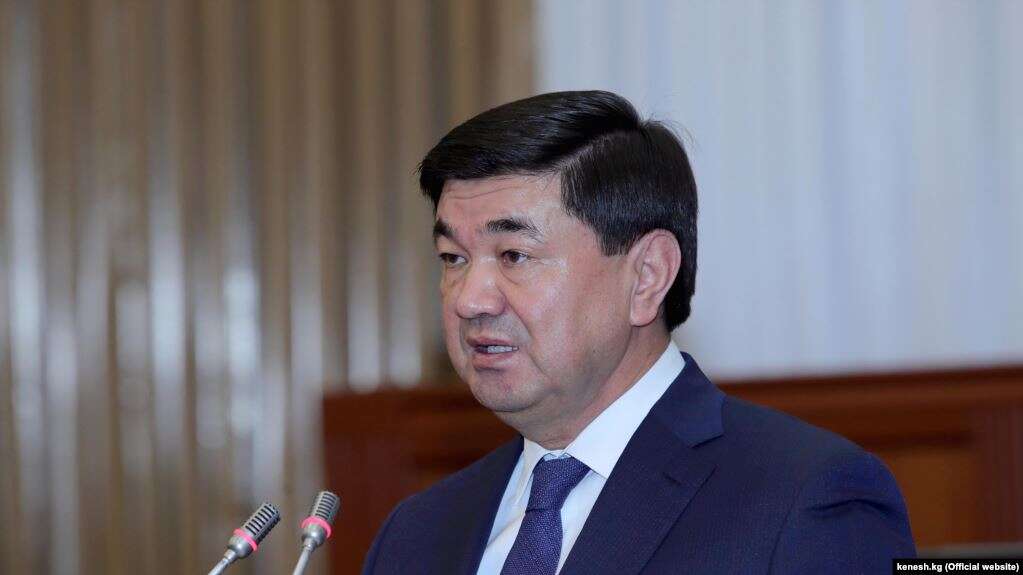
Radio Liberty’s Kyrgyz Service says Kyrgyz Prime Minister Mukhammedkalyi Abylgaziyev has resigned, citing an ongoing criminal investigation into the assignment of national radio frequencies.
Abylgaziyev reportedly announced his resignation in a statement on June 15, saying: "I have nothing to do with this case, and the accusations made against me have no basis."
Noting he hadn’t been questioned, Abylgaziyev said the corruption probe undermined trust in the government and limited its ability to combat the coronavirus pandemic.
"In today's difficult conditions, when the country confronts the threat of coronavirus infection and struggles with its impact on the economy, the government must work in a state of stability and enjoy the full confidence of citizens," Abylgaziyev said.
Lawmakers had raised suspicions over his involvement in the suspect sale of radio frequencies involving a leading cable television company and a major telecoms company, even though he has not been named as a suspect by the investigators, according to RFE/RL’s Kyrgyz Service.
Abylgaziyev reportedly took a two-week leave of absence on May 27 “in order to avoid accusations of exerting any pressure on the course of the investigation.”
He was appointed as prime minister by President Sooronbai Jeenbekov on April 18, 2018, replacing Sapar Isakov.
Jeenbekov's Social Democratic Party leads a majority coalition in parliament, which must now nominate a new prime minister.
The Prime Minister of Kyrgyzstan is the head of government of Kyrgyzstan. Until 2010, the President was in a stronger position than the Prime Minister in Kyrgyzstan, but after the 2010 constitutional referendum, the state transitioned to a parliamentary system, placing greater power in parliament and the cabinet at the expense of the president.
The president is allowed to appoint the Prime Minister temporarily, and his appointment is known as the acting Prime Minister. The acting Prime Minister becomes a full Prime Minister by being confirmed by the Supreme Council (parliament). The Prime Minister then forms the cabinet.