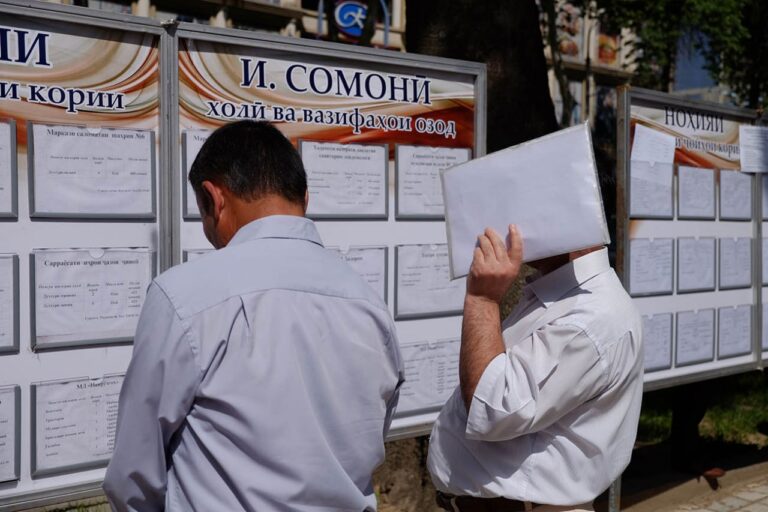
Electronic data collection technologie are expected to be used in this year’s population and housing census in Tajikistan.
According to the Agency for Statistics under the President of Tajikistan, three methods will used this year in the population and housing census — Internet survey, survey using a tablet with special software, and traditional census approach (paper questionnaire).
This year, the population and housing census will be held in Tajikistan from October 1 to October 15.
The Agency for Statistics calls on all ministries and agencies, enterprises and organizations irrespective of their forms of property to contribute to holding the census via the Internet.
“It is necessary to create a special room — a terminal with access to the Internet — in each ministry and agency. Employees of the statistical bodies are ready to carry out an explanatory work in ministries and agencies,” says a statement released by the Agency for Statistics.
The previous population and housing census was held in Tajikistan in 2010. As of the early fall 2010, Tajikistan’s population was 7.565 million, 1.438 million people more than in 2000.
According to the official statistical data, the current population of Tajikistan is 9,577,417 as of September 10, 2020.
By the beginning of the next year, Tajikistan’s population is expected to reach 9.688 million. The population growth rate will be 2.5 percent, one of the highest rates in the world.
Population and housing censuses provide a wide range of information on population and housing units. They allow detailed disaggregation of data by small geographic areas and small population groups. However, it is widely recognized that conducting a population and housing census is one of the most expensive and complex data collection operations, comprising of a series of many interrelated activities. As widely recognized, the traditional census approach using paper questionnaires exposes census data to different types of human errors throughout the census processes, especially during mapping, enumeration and data processing. In order to decrease such errors, the census operation usually includes additional procedures for monitoring and controlling errors. More importantly, dependency on manual input creates pressure on the timeliness of the dissemination of census data. National statistical ofices (NSOs) are increasingly facing a number of challenges in conducting population and housing censuses, particularly decreasing response rates, timely dissemination of census results and increasing data collection costs. These challenges are compelling NSOs to investigate alternative ways of implementing the census. Recent technological developments have offered NSOs many opportunities to modernize their census operations, especially with regard to constructing censusmaps, capturing and validation of census data and dissemination of census results. The use of technology has become an integral part of many census processes critical for improving the cost, quality (coverage, accuracy, timeliness) and efficiency of the census. The rapid expansion in mobile connectivity, and rapid progress in technological innovation more broadly (such as cloud computing, smart mobile devices, GPS, web GIS), provide new opportunities for increasing the quality and speed with which census data can be collected. Data collection with computer-assisted self-interview (CASI) with the use of the Internet and with computer-assisted personal interviewing (CAPI) on tablets or laptops have become an increasingly attractive substitute to using paper questionnaire, administered by an interviewer (PAPI) or self-administered (PASI).