The Dialogue of Civilizations Research Institute (DOC) styles itself as "a think tank that researches and develops proposals that address key challenges faced by the international community," but its sources of funding, however, are opaque, Eurasianet says.
An investigation by the German news outlet Deutsche Welle found that the institute's primary funding sources were close to the Kremlin, in particular Vladimir Yakunin, a former top operative in the Soviet security services. The DOC also has satellite offices in Moscow, Vienna and New Delhi.
Although it proclaims to be an "independent platform for dialogue," it doesn't take much digging to find Kremlin ties. Not only did Yakunin found and fund the organization, but he still acts as the chairman of the supervisory board. As one German newspaper detailed, the DOC was set up to "become the headquarters of a worldwide network of Russian think tanks," in which Yakunin and his allies would "make the Russian view of the world popular." Experts on Russian influence operations have described the DOC as everything from "the Kremlin's main propaganda 'factory' in the West" to a "KGB team-building" exercise.
Until last year, much of DOC's time and energy had been devoted to cultivating Western political figures and experts – including with an annual conference it sponsors in Greece, the Rhodes Forum – to help build and legitimize the entity's reputation as a source of expertise. Politico has described the Rhodes Forum as the "Putin adoration society."
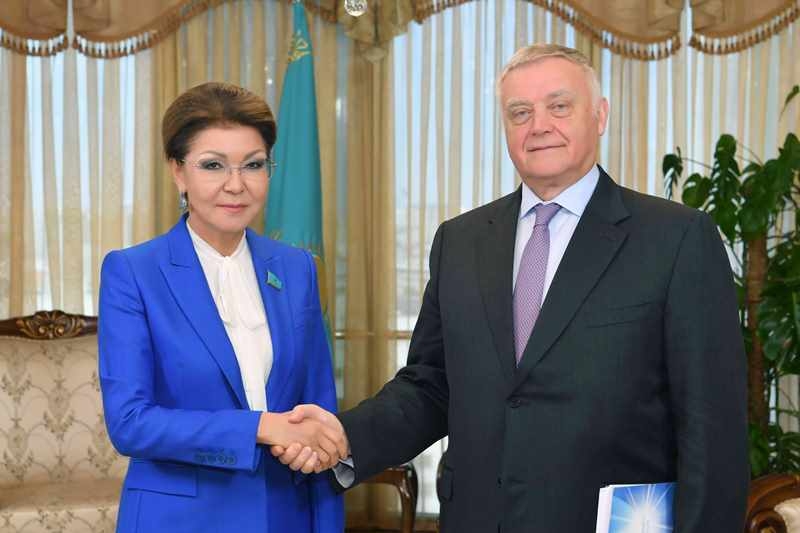
Sitting on the group's supervisory board alongside Yakunin is a former Kyrgyz prime minister, Joomart Otorbayev. A number of Chinese nationals also join Yakunin and Otorbayev in the group's leadership ranks, including Wang Huiyao, the president of the Center for China and Globalization, and Li Xin, the director of Russian and Central Asian Studies at the Shanghai Institute for International Studies.
Another member of the supervisory board (and reportedly a major DOC donor) is Ruben Vardanyan, who, in an investigation conducted by the Organized Crime and Corruption Reporting Project, was linked to the Troika Laundromat money laundering network.
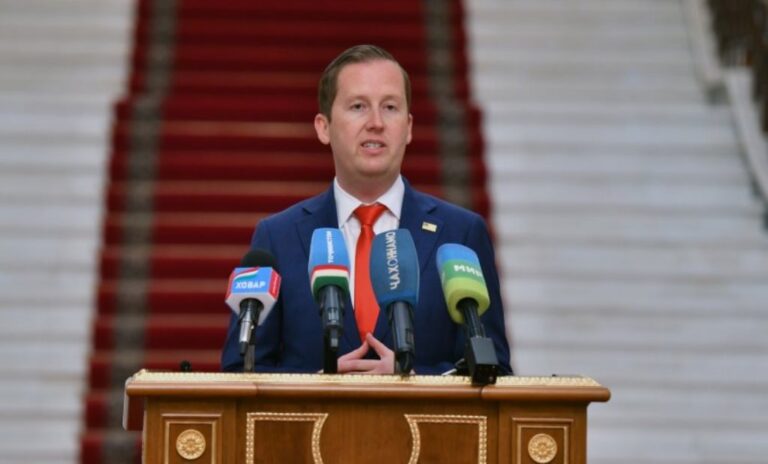
Illustrating the group's growing interest in Central Asia and China, the DOC organized a symposium in late 2019 at the Tajik National University in Dushanbe. The event examined regional "brain drain," and brought together a "target group… made up of academics from Central Asia, with a special focus on young researchers."
Another project, according to the organization's most recent annual report, studied a trend characterized as "social barbarism," a term the DOC did not clearly define. The project featured both the Kazakhstan Institute for Strategic Studies and the Uzbek Ministry of Foreign Affairs as formal partners. The DOC further described the Kazakhstan Institute for Strategic Studies and Tajik National University as "important intellectual partners."
Other "partner organizations" listed by the DOC include Beijing University in China. The DOC also noted that the Rhodes Forum has "strengthened" the entity's connections with the China Global Television Network (CGTN), a Chinese state-controlled broadcaster that is widely perceived as a key international vehicle to advance Chinese Communist Party policy priorities.
The DOC is also trying to make inroads into India. Not only has the group opened an office in New Delhi, but it held its first formal seminar in the country last year. The event, titled "India in a Changing World," included former Indian Vice President Hamid Ansari and former Austrian Chancellor Alfred Gusenbauer.
Yakunin, the DOC's impresario, is currently the subject of sanctions by a number of Western governments, including Australia, the United States, and Canada, in connection with Russia's occupation of Crimea in 2014. A 2017 profile published by the Quartz news website described Yakunin as skilled in the art of "reputation laundering."