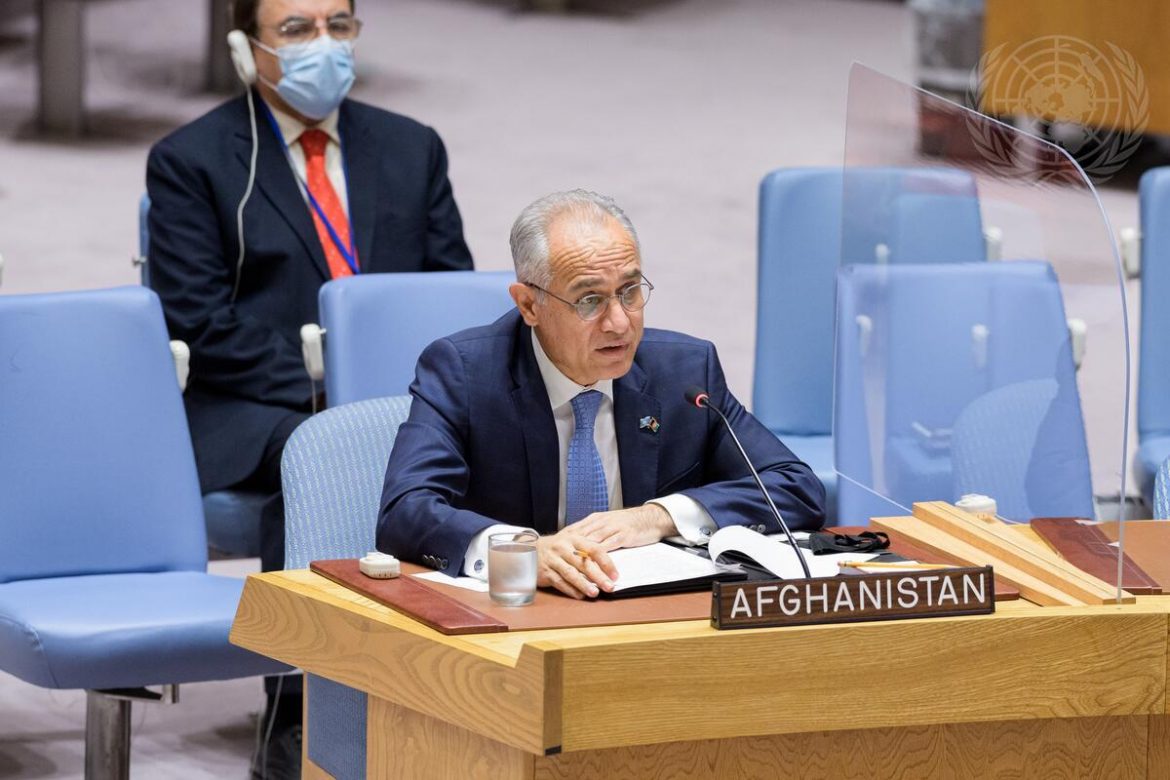
Ambassador Ghulam M. Isakzai, the Permanent Representative of Afghanistan to the United Nations, have accused the Taliban of having links with terrorist organizations such as Al Qaeda and ISIL
In a statement delivered at the UN Security Council Briefing on the situation in Afghanistan, Ambassador Isakzai, in particular, noted on August 6 that the situation in Afghanistan has been rapidly deteriorating due to the recent escalation of violence by the Taliban and their brutal military offensives on major cities and population centers in several provinces.
Since mid-April, the Taliban and their affiliate foreign terrorist groups have launched more than 5,500 attacks in 31 of the 34 provinces of Afghanistan, he noting that those attacks have been launched with the direct support of more than 10,000 foreign terrorists fighters representing 20 groups including Al-Qaeda, LeT, TTP, IMU, ETIM, and ISIL who entered Afghanistan are fighting alongside the Taliban against “the population and security forces.”
Afghan diplomat says there is mounting evidence that the East Turkestan Islamic Movement and the Islamic Movement of Uzbekistan which has pledged allegiance to ISIL fought alongside the Taliban in Faryab, Jowzjan, Takhar, and Badakhshan provinces where they are currently present with their families under the Taliban’s control.
According to him, the link between the Taliban and these transnational terrorist groups is stronger today than at any point in recent times.
“In fact, these links are unbreakable as they have been cultivated and built on shared ideology, interests and goals, and inter-marriages which have been translated into joint attacks, logistical and material support,” said Ambassador Isakzai. “The implication of allowing this network to continue to grow inside the country carries great security risks not only for Afghanistan but also for the wider region and even the world.”
Their links to drugs, to smuggling, to robbing of our natural resources, is reportedly unprecedented. And those who encourage and participate with them of course are the beneficiaries.
Therefore, this is not a civil war but a war of criminalized and terrorist networks fought on the back of Afghans, Afghan diplomat added.
It is to be noted that Central Asian citizens are now operating in northern Afghanistan, fighting alongside the Taliban. There citizens of Tajikistan, Uzbekistan, and even reportedly some from Turkmenistan, who are in the ranks of militant groups active in northern Afghanistan, some who are allied with the Taliban, some who are not.
Recall, Radio Liberty’s Tajik Service reported on July 27 in some of the areas along Tajikistan's border with Afghanistan, which were recently captured by the Taliban, a militant group from Tajikistan, Jamaat Ansarullah, is now in charge. When the Taliban captured a strategically important security checkpoint near Afghanistan's border with Tajikistan in June, it assigned a Tajik militant to raise the Taliban flag on the site.
The Taliban reportedly put Tajik militant Mahdi Arsalon and his group of fighters from Tajikistan in charge of security in five districts the Taliban seized near the Tajik border in recent months. The districts are Kuf Ab, Khwahan, Maimay, Nusay, and Shekay — all parts of Afghanistan’s Badakhshan Province.
According to several sources in Tajikistan, Mahdi Arsalon’s real name is Muhammad Sharifov. Sharifov, 25, was born in the village of Sherbegiyon in Tajikistan’s eastern Rasht Valley.
Arsalon and other Tajik militants are known in Afghanistan as the “Tajik Taliban”, but in reality they are members of Jamaat Ansarullah, which the only Tajik-founded terrorist group.
Jamaat Ansarullah — also known as Ansarullah — was founded by a rogue former Tajik opposition commander Amriddin Tabarov a decade ago with the ultimate goal of overthrowing the government in Dushanbe.
Tabarov, also known as Mullah Amriddin, had been a field commander for anti-government Islamist forces during Tajikistan's devastating 1992-97 civil war. He joined the Islamic Movement of Uzbekistan (IMU) in the late 1990s, fighting first in northern Afghanistan and then moving into Pakistan after the Taliban regime was ousted from power.
In 2010, Tabarov founded Jamaat Ansarullah — a militant group that maintained links with the IMU. Amriddin Tabarov was killed by Afghan security forces in 2015.
Dushanbe accuses Jamaat Ansarullah of two terrorist acts in 2010: a suicide bombing in Khujand that killed three police officers and an ambush in the Rasht Valley that left 25 troops dead.
In May 2012, Tajikistan’s Supreme Court officially banned Jamaat Ansarullah as a terrorist group on the basis of a suit filed by the Prosecutor-General’s Office.