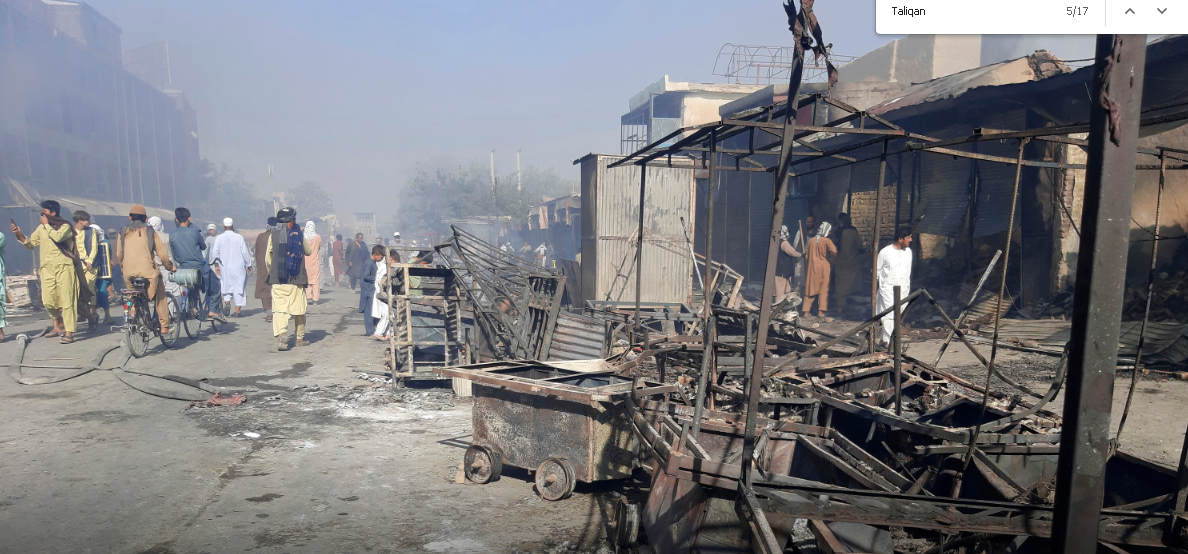
The Taliban captured three more provincial capitals on August 8 as they take their fight to the cities after seizing much of the countryside in recent months.
Media reports say the Taliban militants have snatched up five provincial capitals in Afghanistan since August 6.
The National says the Taliban captured Afghan provincial capitals Kunduz and Sar-e Pul on Sunday, though some fighting was reported to be continuing.
This comes after the Taliban militants seized control of the capitals of Jawzjan and Nimruz provinces in the previous two days.
The battle for Kunduz, a city of 270,000 people, and capital of northern Kunduz province, had reportedly raged since Saturday evening. Local officials confirmed the cities had fallen and the Taliban posted videos purporting to show the group's fighters inside government buildings in Kunduz, according to The National.
Similar reports were shared by a local journalist from Sar-e Pul, capital of northern Sar-e Pul province.
“The province has completely fallen to the Taliban. They have taken over the governor's building. Only the airport and police chief’s headquarters remain with the government,” Rahima Gul, who requested her name be changed, told The National.
Parwin Azimi, a women's rights activist in Sar-e Pul, told AFP by phone that government officials and the remaining forces had retreated to an Army barracks about three kilometers from the city.
Kunduz, a major northern hub, is the most significant gain for the Taliban militants since they launched an offensive in May, as foreign forces began the final stages of their withdrawal from the country.
The fall of Kunduz and Sar-e Pul fuels the insurgents’ pushes in Taliqan, the capital of Takhar province.
Citing Keramatullah Rustaqi, a Takhar provincial council member, The New York Times says the city had fallen to the Taliban and that “security forces left Taliqan to retreat to Farkhar,” a neighboring district.
Mr. Rustaqi reportedly added that government forces were ambushed along the way.
Like Kunduz, Taliqan borders Tajikistan. The city was the operations center of Ahmad Shah Massoud, an anti-Taliban militia commander who was killed on September 9, 2011
The fall of Kunduz, Sar-e Pul and Taliqan is a devastating blow to the Afghan government just weeks before the final withdrawal of U.S. troops.
The rapid fall of Afghan cities on Sunday — including Kunduz, Sar-e Pul and Taliqan, all northern capitals — comes just weeks before U.S. forces were set to complete a total withdrawal from Afghanistan. The New York Times says it is a crucial challenge for President Biden, who in recent weeks has insisted the American pullout would continue despite the Taliban’s advances.
After sweeping through the country’s rural areas, the Taliban militants’’ military campaign has shifted to brutal urban combat in recent weeks. They have pushed into the edges of major cities like Kandahar and Lashkargah in the south and Herat in the west.
The strategy has exhausted the Afghan government’s forces and overwhelmed the local militia forces that the government has used to supplement its own troops.