ISIS terror group claims responsibility for Kabul airport blasts that leave more than 100 dead

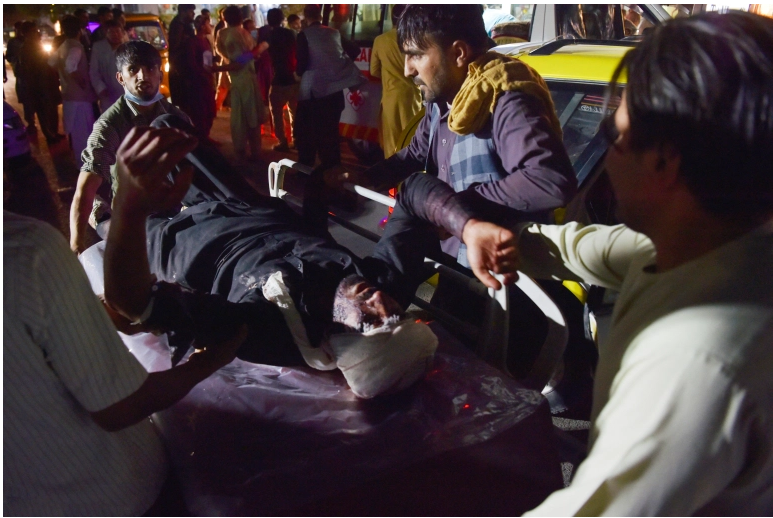
Media reports says more than 100 people were killed, including at least 13 U.S. service members and 90 Afghans, at the Kabul airport Thursday when two blasts ripped through crowds trying to enter the American-controlled facility.   A suicide bomb attack at the airport’s Abbey Gate was reportedly followed by an assault by gunmen.  Another bomb […]

Media reports says more than 100 people were killed, including at least 13 U.S. service members and 90 Afghans, at the Kabul airport Thursday when two blasts ripped through crowds trying to enter the American-controlled facility.  

A suicide bomb attack at the airport’s Abbey Gate was reportedly followed by an assault by gunmen.  Another bomb attack reportedly took place nearby, at a hotel outside the airport. Eighteen U.S. service members were injured, the Pentagon said, according to The World Street Journal.

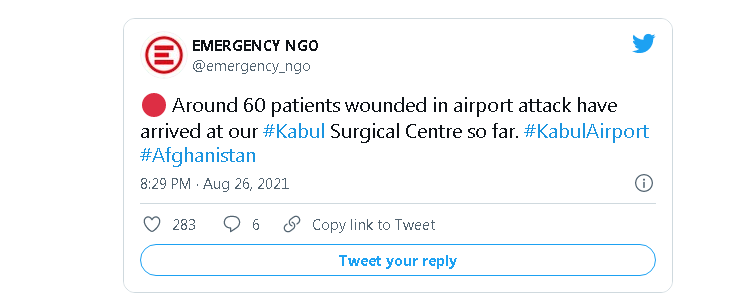
The city’s main Emergency Hospital said on Twitter yesterday evening, at around 8:30 pm, that at least 60 wounded people were transferred to their facility so far.
Citing its sources, Al-Jazeera says tens of thousands of people had been waiting outside the Abbey Gate earlier in the day.  The explosions reportedly came after US officials and allies had warned people not to come to the area around Hamid Karzai International Airport due to the threat of an attack.

The Afghan affiliate of the ISIS (ISIL), known as the Islamic State Khorasan Province, ISKP (ISIS-K), claimed responsibility for the attack.

The blast marks the first such attack in the country since the Taliban took control of Kabul 10 days ago and before the group had fully announced its new government.

The Wall Street Journal says the attack marked the deadliest day for the U.S. military in Afghanistan since 2011, and came just five days before the Biden administration’s deadline for the complete military withdrawal from the country.  The military expects more attacks, Marine Corps Gen. Frank McKenzie told reporters.

According to The World Street Journal, U.S. President Biden on Thursday evening said he was heartbroken by the violence and vowed to retaliate for the attacks, while promising to continue evacuation efforts.

“We will hunt you down and make you pay,” Mr. Biden said in remarks at the White House.  He said he had instructed his national security advisers to develop response plans to the attack.

 

Join us on social media!

Article translations:

Related Article

Оби зулол
Оби зулол
Tenisi

Most Read

Коммерсбонк Точикистон

Recent Articles

RZD announces the restoration of passenger services between Moscow and Dushanbe

Direct rail services between the capitals of Russia and Tajikistan were suspended in March 2020 due to the COVID-19 pandemic.

#AP30/Stories. “Selam! Heller nichek?” How Tatars live today in Sughd province

On the 30th anniversary of "Asia-Plus," we continue to publish reports that remain relevant even after years. This story was told in 2021, and since then, little has changed in the life of the Tatar community in Tajikistan.

15,000 cameras, drones, and robots: how technology monitors pilgrims in Mecca and Medina

During Hajj 2026, Mecca and Medina were under unprecedented digital control.

Another child in Dushanbe removed from family and sent to boarding school

The Ministry of Internal Affairs reports that the parents did not pay adequate attention to the child.

Emomali Rahmon instructs to address issues in seed production following criticism of the industry

Issues have been noted with certification, seed quality, and the material and technical base of the industry.

Water, climate, and a $130 billion deficit: seven key outcomes of the Water Conference in Dushanbe

At the forum, countries and international organizations discussed new mechanisms for cooperation, investments, and technologies that are essential for addressing the global water crisis.

Eskhata Bank introduces a new generation children’s wallet

"Eshkata Bank" has created a full-fledged digital platform that helps children aged 7 to 16 learn how to manage money.