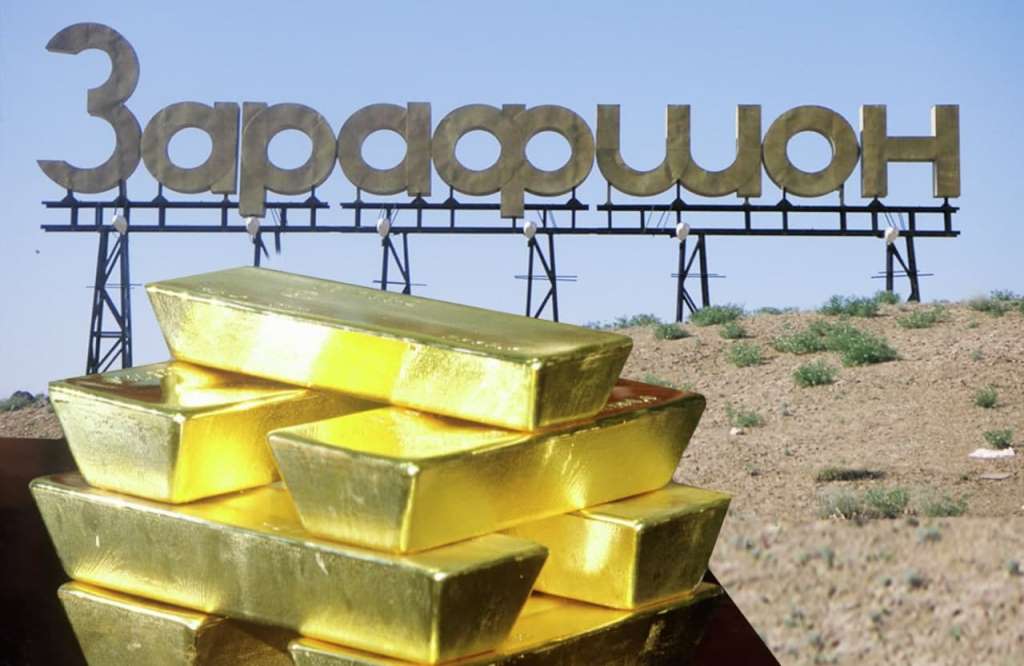
The Government Tajikistan has issued a regulation in late October giving the Tajik-Chinese joint gold mining venture, JV Zarafshon, permission to carry out the complex development of gold-bearing deposits Taror and Jilau located in an area subordinate to the Tajik northern city of Panjakent.
The draft agreement provides for construction by JV Zarafshon of a metallurgical plant for complex extraction of gold and copper from copper-gold concentrates by pressed oxidation.
It is expected that the construction of the plant will be completed within two years and it will be introduced into operation by the end of 2023.
JV Zarafshon undertakes to invest 117 million U.S. dollars in stages in the complex development of the mentioned gold-bearing deposits and construction of the metallurgical plant.
The agreement will be valid for 10 years from the date of entry into force.
Tajik-Chinese JV Zarafshon (formerly Zervashan Gold Company) is the largest gold mining company in Tajikistan.
Zeravshan Gold Company (ZGC) was launched as a joint venture with Nelson Resources Ltd (44%) and the Tajikistan government (51%) and the IFC (5%) in 1994. In September 2002, Avocet signed a heads of agreement to acquire the Tajik gold assets of Toronto-based Nelson Resources Ltd held through Nelson’s subsidiary, Commonwealth and British Minerals Ltd. The assets included a 44% interest in ZGC. In November 2004, Avocet increased its equity interest in ZGC from 49% to 75%. In late July 2007, Avocet sold its equity stake in ZGC to China’s Zijin Mining.
JV Zarafshon reportedly owns gold mining and exploration rights to a 300,000-hectare area near the town of Panjakent in northern Tajikistan. The main gold deposits are Taror, Jilau, Khirskhona and Olimpyskoye.
Tajikistan has 137 deposits with estimated reserves of industrial gold and 127 deposits of non-industrial gold. Tajikistan plans to increase annual production of gold to 17 tons beginning on 2022.
Four large gold mining companies now operate in Tajikistan: Tilloi Tojik; Tajik-Chinese JV Zarafshon; Tajik-Canadian JV Aprelevka; and China Nonferrous Gold Limited, which is the first foreign company to obtain 100% ownership of a mining and exploration project in Tajikistan. Besides, enterprises such as Odina, Nazira, Ganj, Barakat and Istiqlol are engaged in gold production in the country.
Most of gold comes from the Jilau deposit operated by JV Zarafshon, which reportedly accounts for more than 70 percent of the total amount of gold produced in Tajikistan.