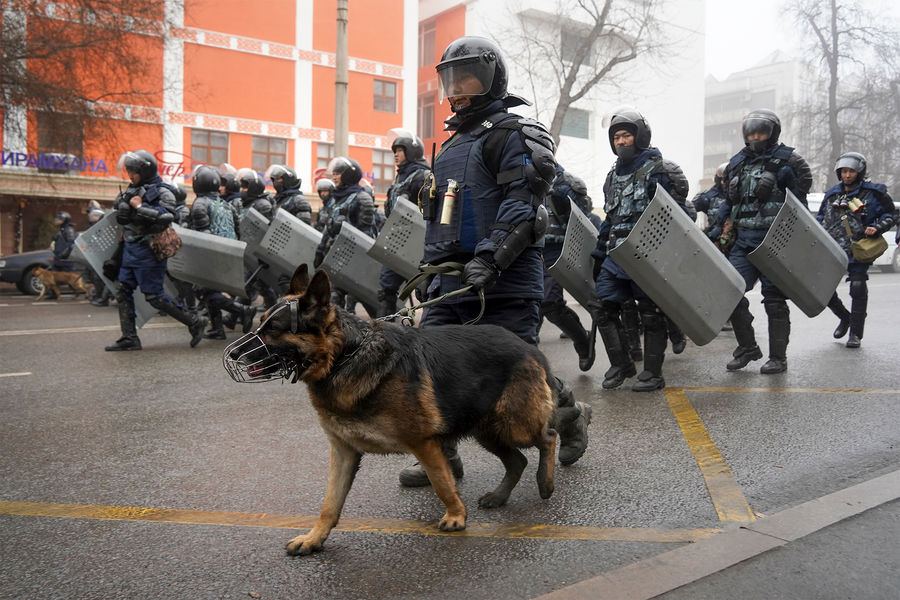
Kazakhstan’s republican task force for combating terrorism on January 6 has introduced a critical “red” level of terrorism hazard throughout the country.
TASS, citing the press center of Kazakhstan’s National Security Committee (KNB), says a meeting of the republican task force for combating terrorism, presided over by KNB chief, Yermek Sagimbayev, took place in Nur-Sultan on January 6.
The head of task force in coordination with the President reportedly introduced a critical “red” level of terrorism hazard throughout the territory of Kazakhstan. “An anti-terrorist operation regime is in effect in all regions,” the KNB said in a statement.
The red level of terrorist hazard means that authorities can conduct personal searches and inspections of belongings, vehicles, temporarily restrict or prohibit their movement; have unimpeded access to residential and other premises; take measures such as the monitoring of conversations and other information transmitted through telecommunications systems.
The red level of terrorism hazard reportedly also means full mobilization and combat readiness of all security forces, as well as the strengthening of security measures.
The protests began in the west of the country at the weekend, January 2, after a sharp rise in fuel prices, but have spread quickly and taken Kazakhstan’s authorities and international observers by surprise.
On Wednesday, there were further reports of violent clashes and shooting in Almaty and other cities, as well as unverified videos suggesting casualties among protesters.
Earlier in the day, the Almaty mayor’s office was set on fire, with smoke and flames visible from several floors of the imposing building. Many flights were diverted or cancelled after the apparent storming of the airport. Kazakh media outlets reported authorities took the airport back under control after a firefight.
In other cities, including Aktobe in the west of the country, crowds tried to storm government buildings. There were reports and videos of police cars set on fire and security vehicles seized by the crowd.
On Wednesday, Kassym-Jomart Tokayev accepted the government's resignation. Earlier Wednesday, President Tokayev declared a state of emergency in Almaty and Mangystau region for the period until January 19.
Media reports note that police in Kazakhstan’s largest city, Almaty, said early on January 6 that dozens of rioters had been “liquidated” over the past day as demonstrators stormed government buildings, set them on fire, and looted businesses.
Angry demonstrators, some of whom were armed with rubber truncheons, sticks, and shields, reportedly set fire to a presidential residence and the mayor’s office in Almaty, where protesters also temporarily seized control of the airport. The airports in Almaty and one other city were shut down.
The government has reportedly blocked the Internet and disrupted mobile phone signals. Media has also been restricted.
Kazakhstan’s Interior Ministry said that 18 security personnel were killed in clashes with protesters and more than 2,000 people were arrested.
Radio Liberty’s Kazakh Service reported on January 7 that an unknown number of people have reportedly been killed in at least two smaller towns.
Since the protests erupted earlier this week, the Health Ministry reportedly said more than 1,000 people have been injured and 400 hospitalized. Sixty-two people are in the intensive care unit.