Boeing's long-term airline industry forecast has excluded sales to Russia and Central Asia. The company had previously predicted sales of 1,540 aircraft to buyers in the region. The Commercial Market Outlook (CMO) 2022-2024 notes that the plane manufacturer has cut its long-term industrywide forecast due to uncertainty over the impact of sanctions against Russia.
Boeing has reportedly lowered its projected demand for commercial aircraft over the next two decades due to the prospect of a global economic crisis and uncertainty over the supply of airliners to Russia.
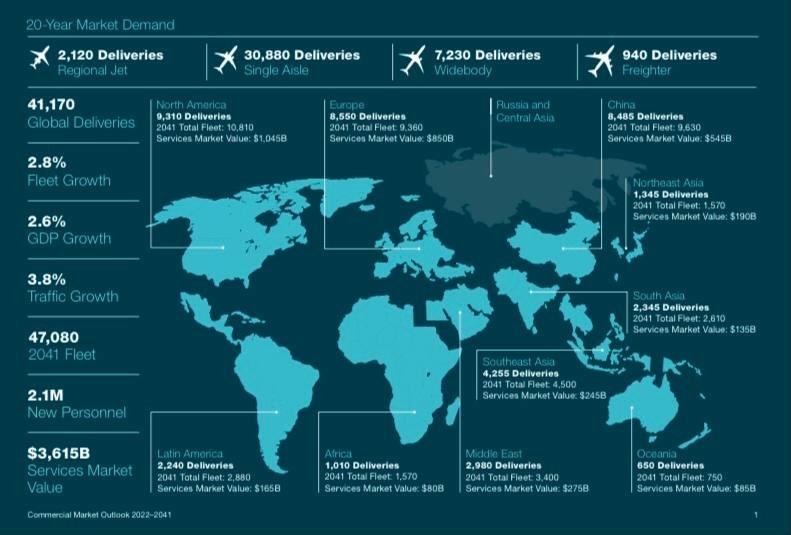
The American Aircraft Corporation plans to hand over 41,200 aircraft to customers by 2041. Bloomberg notes that a year earlier, this figure was higher in the forecast – 43.6 thousand. Boeing also cut its full-year passenger growth forecast from 4 percent to 3.8 percent.
Degrading expectations means that geopolitical and economic upheavals could have long-term implications for the commercial aerospace industry. Boeing's European rival Airbus has also cut its ridership projections over the next two decades, citing rising energy prices.
Most of the aircraft that fell out of the forecast – 1500 aircraft Boeing was going to transfer to Russia. Now the corporation has presented a supply map for 2022-2041, where Russia and Central Asia are shaded in gray – no supplies are planned.
Reuters says Darren Hulst, vice president of commercial marketing at Boeing, told reporters ahead of the report's release that Boeing's view "of medium-term recovery" is "largely unchanged.".
"Overall, we still see late 2023, early 2024 as the time where the industry recovers to full or at least the level of pre-pandemic traffic," he said.
At the same time, the corporation believes that sales of new aircraft will be stable over the next decade, as airlines have to increase their fleet to meet the recovering demand for air travel after the pandemic. Boeing forecasts that operators will need 19,575 new aircraft through 2031, compared to 19,330 last year forecast through 2030.