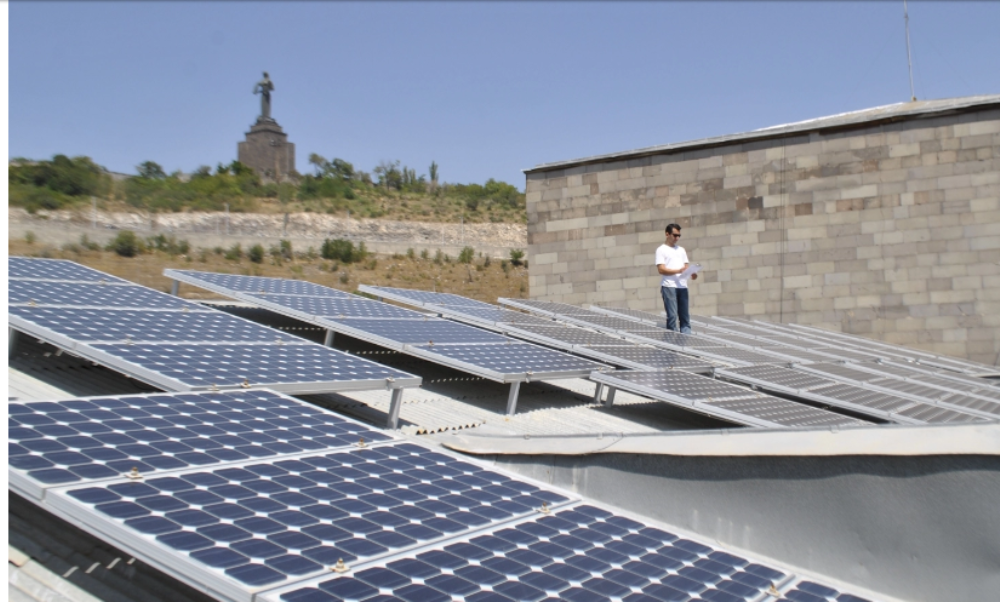
The Eurasian Development Bank (EDB) will provide up to US $37 million to finance the construction of 11 solar power plants (SPPs) with a total capacity of up to 65 MW in the Gegharkunik and Aragatsotn Regions of Armenia.
According to the EDB press center, the relevant documents were signed in Yerevan on August 4 by Nikolai Podguzov, Chairman of the EDB Management Board, and Hayk Harutyunyan, President of the New Energy Group.
All the facilities are reportedly scheduled to be commissioned this year. The investment will be repaid from payments under electricity sales contracts between the borrower and the Electric Networks of Armenia.
Developing renewable energy sources (RES) is a priority of the Armenian government’s energy strategy. RES reduce the country’s dependence on fossil fuels, which are fully imported. The priority of RES and the intentions of Armenia’s government for their development are enshrined in the nation’s 2021–2040 Energy Strategy.
The potential of solar power plants in Armenia is estimated at 8 GW. The average annual sunshine is 2,700 hours while the average annual solar radiation falling on a horizontal surface is about 1,720 kWh per sq. m (the European average is 1,000 kWh per sq. m). A quarter of the country is endowed with solar energy resources of 1,850 kWh per sq. m per year.
“Today, Armenia’s energy system is based on thermal, nuclear and hydroelectric power. Natural gas remains the largest source of total energy supply and the main energy carrier in total final consumption. According to our strategy in Armenia, the EDB focuses on distributed solar power projects and the construction and modernization of hydropower facilities. The Bank’s objective until 2026 is to help diversify the country’s sources of electricity generation. In doing so, we not only increase the reliability of the energy system, but also significantly improve the environment by reducing carbon emissions,” said Nikolai Podguzov, Chairman of the EDB Management Board.
And what about solar power in Tajikistan?
Tajikistan is a country rich in water resources, the mountainous terrain and the presence of rivers allows the construction of high dams and large hydroelectric power plants (HPPs). 95% of electricity in Tajikistan is generated by hydropower plants. The use of hydropower plants in itself is considered a “green” way of generating electricity, but still, according to exports, it is necessary to think about alternatives. And solar power is of great importance for Tajikistan.
The potential of solar energy in Tajikistan is quite high. The country is located between 36°40 and 41°05′ north latitude. Meteorologists call this zone a “golden belt” of sunshine.
According to the Agency of Hydrometeorology of Tajikistan, the duration of sunshine in the country is 2100-3166 hours per year, and the number of sunny days per year ranges from 260 to 300. This provides great opportunities for the use of solar energy as an alternative, especially in mountainous regions where there are no power lines.
Preliminary calculations of the Ministry of Energy and Water Resources of Tajikistan (MoEWR) show that the potential for the use of solar energy is 3,103 billion kWh per year.
Tajikistan’s largest solar power plant is situated in Murgab district of Gorno-Badakhshan Autonomous Region (GBAO).
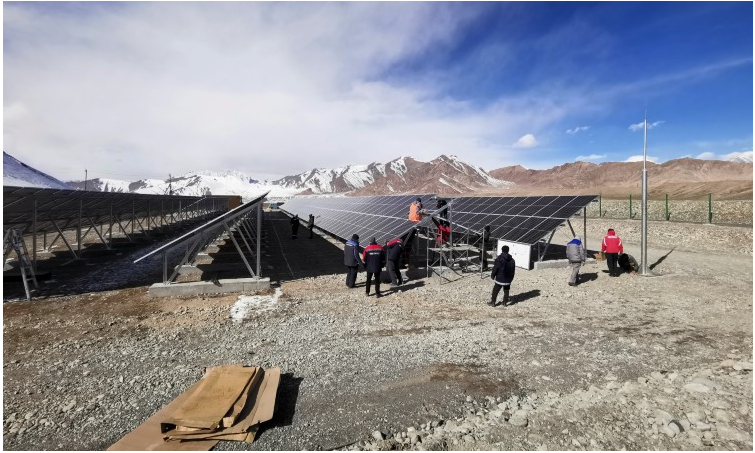
The 220-kilowatt Murgab solar power plant was officially introduced into operation on November 12, 2020.
This solar power plant is a direct result of successful cooperation between the Government of Tajikistan, the United States Agency for International Development (USAID), and Pamir Energy Company. At request of the Tajik MoEWR, USAID supported the installation of the solar plant in Murgab to complement the nearby 1.5 megawatt ‘Tajikistan’ (formerly Aksou) hydropower plant and add additional clean, renewable energy to the local grid.
Murgab’s installation reportedly represents a 50 percent increase in daytime electricity – meaning communities are now able to pursue activities throughout the day, children can attend heated schools, and homes have power and heat during the long and bitterly cold winter months.