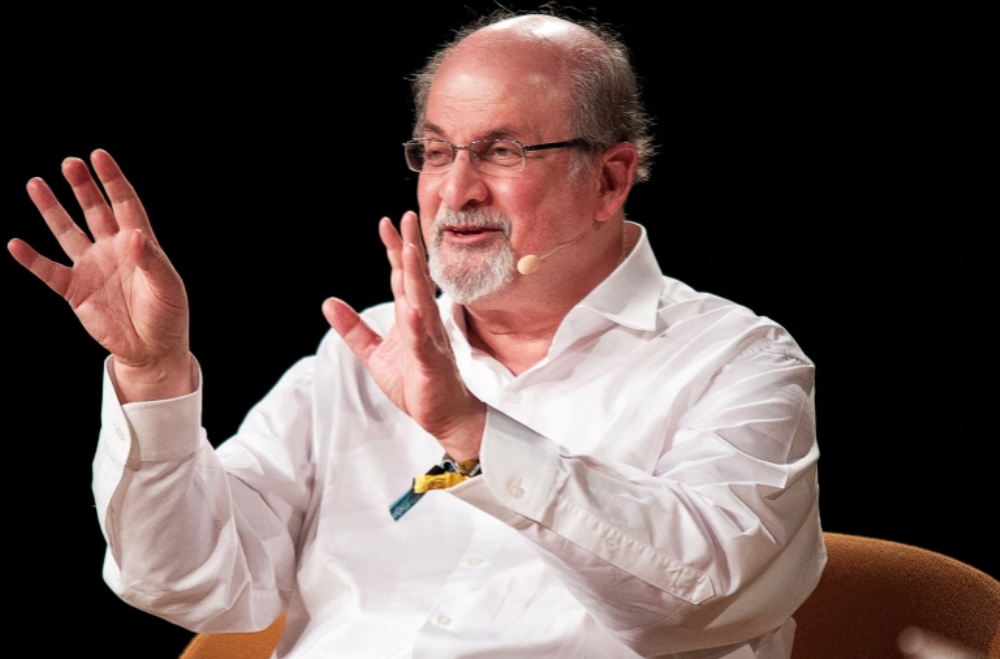
Media reports said yesterday that author Salman Rushdie has been taken off a ventilator and can talk again, nearly two days after being stabbed.
Mr. Rushdie, 75, was attacked while speaking at an event in New York and was in a critical condition.
His agent Andrew Wylie said Rushdie’s agent, Andrew Wylie, confirmed that information, according to Al-Jazeera.
“He’s off the ventilator so the road to recovery has begun,” said Wylie. “It will be long; the injuries are severe, but his condition is headed in the right direction.”
The man charged over Friday's attack has pleaded not guilty to attempted murder, and has been remanded in custody without bail.
Hadi Matar, 24, is accused of running onto the stage and stabbing Mr. Rushdie at least 10 times in the face, neck and abdomen.
Sir Ahmed Salman Rushdie (born 19 June 1947) is an Indian-born British-American novelist. His work often combines magical realism with historical fiction and primarily deals with connections, disruptions, and migrations between Eastern and Western civilizations, set on the Indian subcontinent.
Rushdie's second novel “Midnight's Children” (1981), won the Booker Prize in 1981 and was deemed to be "the best novel of all winners" on two occasions, marking the 25th and the 40th anniversary of the prize. His fourth novel “The Satanic Verses” (1988) was the subject of controversy, provoking protests from Muslims.
Death threats were made against him, including a fatwa calling for his assassination issued by Ayatollah Ruhollah Khomeini, the Supreme Leader of Iran, in 1989. In 2007, Rushdie was knighted for his services to literature. Rushdie's knighthood sparked a scatter of protests across the globe. In 2008, The Times ranked him thirteenth on its list of the 50 greatest British writers since 1945.
It is to be noted that Salman Rushdie spent years in hiding after the leadership of Iran called for his death following the publication of “The Satanic Verses.” But in recent years, declaring “Oh, I have to live my life,” he re-entered society, regularly appearing in public around New York City without evident security. Since 2000, Rushdie has reportedly lived in the United States, mostly near Union Square in Lower Manhattan, New York City.