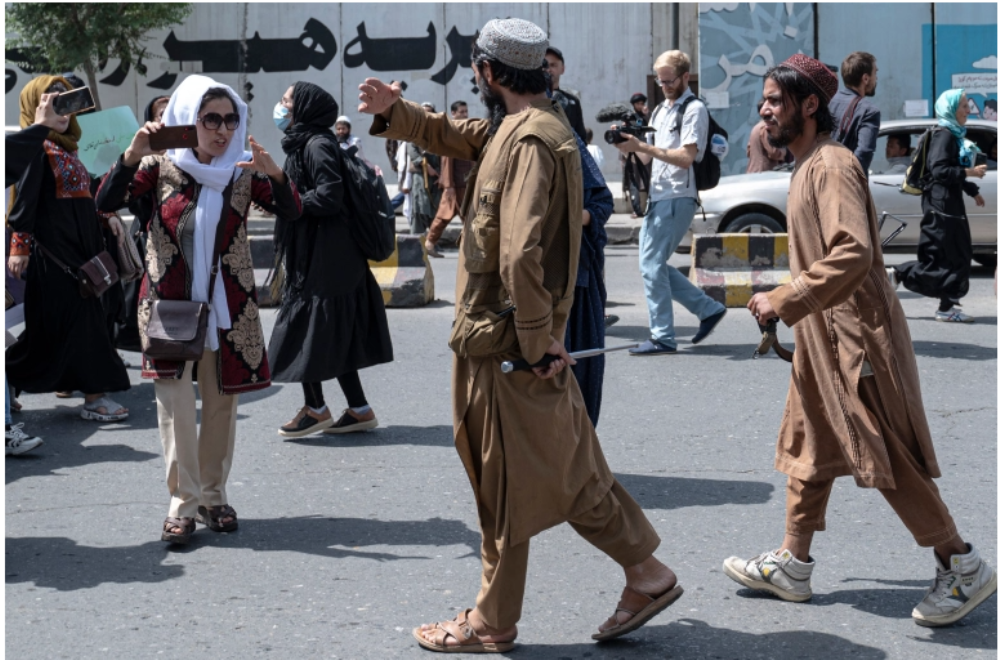
Taliban fighters beat female protesters and fired into the air on Saturday (August 13) as they violently dispersed a rare rally in the Afghan capital, days before the first anniversary of the hardline Islamists’ return to power.
Media reports say that since seizing control on August 15 last year, the Taliban have rolled back the marginal gains made by women during two decades of US intervention in Afghanistan.
Despite the pledges made when it retook power, the Taliban has limited Afghan women’s rights, including keeping high school girl students out of school.
Tens of thousands of girls have been shut out of secondary schools, while women have been barred from returning to many government jobs.
AFP says about 40 women – chanting “bread, work and freedom” – marched in front of the education ministry building in Kabul, before the fighters dispersed them by firing their guns into the air.
Some female protesters who took refuge in nearby shops were reportedly chased and beaten by Taliban fighters with their rifle butts.
The demonstrators carried a banner which read “15 August is a Black Day” as they demanded rights to work and political participation.
“Justice! Justice! We Are Fed up with Ignorance,” they chanted, many not wearing face veils.
“Unfortunately, the Taliban from the intelligence service came and fired in the air,” said Zholia Parsi, one of the organizers of the march. “They dispersed the girls, tore our banners and confiscated the mobile phones of many girls.”
But protester Munisa Mubariz vowed to continue fighting for women’s rights, according to The Guardian.
“If the Taliban want to silence this voice, it’s not possible. We will protest from our homes,” she said.
AFP reports that some journalists covering the demonstration – the first women’s rally in months – were also beaten by the Taliban fighters.
A study by the International Labor Organization (ILO) this year documented a disproportionate drop in women’s employment in Afghanistan – 16 percent in the months immediately following the Taliban takeover. In contrast, male employment dropped by 6 percent.
Prior to the Taliban takeover, women made up 22 percent of the Afghan workforce, according to Al-Jazeera. While the figure was still dismal, it reflected years of social progress in a deeply patriarchal and conservative society like Afghanistan.