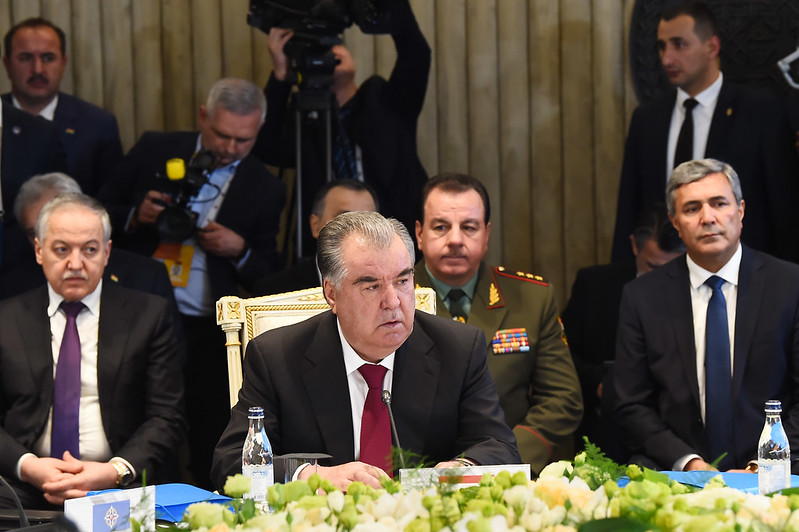
Leaders of the Collective Security Treaty Organization (CSTO) member nations gathered in the Armenian capital of Yerevan on November 23 to discuss security issues.
The summit was attended by Armenian Prime Minister Nikol Pashinyan, Belarusian President Alexander Lukashenko, Kazakh President Kassym-Jomart Tokayev, Kyrgyz President Sadyr Japarov, Russian President Vladimir Putin and Tajik President Emomali Rahmon.
The event was held one-on-one and with the participation of delegations. The leaders reportedly discuss current problems of international and regional security and the main results of CSTO activities during the intersessional period.
The summit participants also took a look at a wide range of issues related to various areas and outlined cooperation venues.
During the discussion of topical regional and international issues, Tajik President Emomali Rahmon reportedly once again raised the issue of security of Tajikistan’s common border with Afghanistan, which is the southern border the CSTO area of responsibility.
The Tajik president’s official website does not give other details of his speech in this context.
It just reported that Rahmon expressed his gratitude to Armenian Prime Minister Nikol Pashinyan for the excellent organization of the work of the meeting and the performance of activities during the presidency of the Organization, and congratulated the President of the Republic of Belarus, Alexander Lukashenko, on the acceptance of the presidency of the Collective Security Treaty Organization.
Emomali Rahmon reportedly also emphasized the effective work of the Secretary General of the Collective Security Treaty Organization, Stanislav Zas, and wished success to the newly appointed head of the Organization, Imangali Tasmagambetov.
A number of documents were reportedly adopted as a result of the meeting of the Collective Security Council of the Collective Security Treaty Organization.
Meanwhile, media reports say Armenian Prime Minister Nikol Pashinyan, speaking at the summit, accused the CSTO of failing to give protection to his country in the face of aggression from arch-foe Azerbaijan.
It is "depressing that Armenia's membership in the CSTO has failed to contain Azerbaijani aggression," said Pashinyan. "This fact is hugely damaging to the CSTO's image both in our country and abroad."
"We have failed so far to make a decision on CSTO's reaction to Azerbaijan's aggression against Armenia," Pashinyan added.
Armenia in September had asked for military help from Moscow, which is obligated under the treaty to defend Armenia in the event of a foreign invasion. But the Kremlin, which also has close ties with Baku, did not rush to help Yerevan and the CSTO responded only by sending its secretary general to the conflict zone and offering to set up a working group to analyze the situation.
In accordance with Article 13 of the CSTO Charter, the Collective Security Council is the highest body of the Organization. The Council considers the fundamental issues of the Organization’s activities and makes decisions aimed at the realization of its goals and objectives, as well as ensures the coordination and joint activities of the Member States to achieve these goals. The Council includes heads of member states. Ministers of Foreign Affairs, Ministers of Defense, Secretaries of Security Councils of Member States, the Secretary General of the Organization, Plenipotentiary Representatives of Member States to the Organization and invited persons can participate in meetings of the Council. The Council has the right to establish, on a permanent or temporary basis, the working and subsidiary bodies of the Organization. The Chairman of the Council is the head of state on whose territory the regular session of the Council is held, unless the Council decides otherwise. His rights and obligations remain with him until the next regular session of the Council.
Created in 1992, the Collective Security Treaty Organization is a Russia-led military alliance grouping the six former Soviet republics of Armenia, Belarus, Kazakhstan, Kyrgyzstan, Russia and Tajikistan.