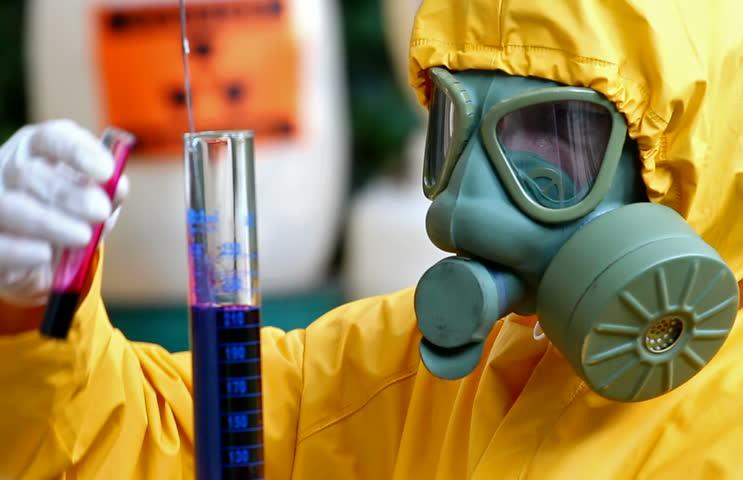
Media reports say the Parliamentary Assembly of the Collective Security Treaty Organization (PA CSTO) has adopted a statement a statement on the inadmissibility of the development of biological and toxin weapons as well as on strict compliance with the Biological and Toxin Weapons Convention (BTWC).
The document, which was endorsed during the 15th PA CSTO plenary session on December 5, in particular, declares the commitment to “a world free of biological weapons.”
"We assume that the state bodies of the CSTO member nations will unite their efforts in coordinating the work on unconditional implementation of the BTWC in the Organization area of responsibility and on enhancement of the legislative framework in this field," the statement reads.
The CSTO PA members noted in the statement that the non-compliance with the Convention could lead to potential biological threats.
"We advocate strict compliance with the 1925 Geneva Protocol for the Prohibition of the Use in War of Asphyxiating, Poisonous or other Gases, and of Bacteriological Methods of Warfare and withdrawal of all reservations for the Protocol," the lawmakers noted.
The CSTO Parliamentary Assembly statement calls on lawmakers of the world to get down to work on perfection of state mechanisms that provide for security and supervision of pathogenic microorganisms and toxins, on reinforcement of international potential within the Convention framework, and on prevention of establishment of parallel mechanism that duplicate the Convention functions and operate in circumvention of the UN Security Council.
"We call to use the Inter-parliamentary Union platform, as well as other international parliamentary organizations, for assistance in implementation of the Convention," the document reads.
Chaired by State Duma (Russia’s lower house of parliament) Speaker Vyacheslav Volodin, joint meeting of the Council of the Parliamentary Assembly of the Collective Security Treaty Organization (PA CSTO) and the 15th Plenary Session of the PA CSTO took place in Moscow on December 5.
Majlisi Milli (Tajikistan’s upper chamber of parliament) Speaker Rustam Emomali heading Tajik parliamentary delegation represented Tajikistan at that meeting.
The PA CSTO is responsible for inter-parliamentary interaction of the IPA CIS members who are also members of the Collective Security Treaty Organization (CSTO). The PA CSTO was established by a resolution “On Measures for Creating a Parliamentary Dimension of the Collective Security Treaty Organization at the CIS Inter-Parliamentary Assembly”, which was adopted on November 16, 2006 to address the priority goals of the development of the CSTO legal framework within the IPA CIS.
The PA CSTO comprises parliamentary delegations from Armenia, Belarus, Kazakhstan, Kyrgyzstan, Russia and Tajikistan. The administrative and legal framework of the PA CSTO is set out in the Provisional Regulations on the Parliamentary Assembly of the Collective Security Treaty Organization dated March 30, 2007. The PA CSTO Chair and the PA CSTO Council of the heads of parliament (parliament houses) oversee the operation of the PA CSTO. The rotating position of the PA CSTO Chair is held for a period of three years. The Secretariat of the IPA CIS Council has a specialized agency that is responsible for the administrative and technical aspects of the PA CSTO. The operation of this agency is supervised by the Executive Secretary of the PA CSTO. The PA CSTO and its Council meet at least twice a year.
The PA CSTO has three standing commissions on defense and security; on political affairs and international cooperation; and on socioeconomic and legal affairs. The PA CSTO Council has a Working Group on the Standardization and Coordination of the CSTO Member States’ Legislations and the Expert Advisory Council. The Information and Analysis Centre operates under the PA CSTO.
The documents regulating the activities of the PA CSTO bodies include Regulations of the Council of the CSTO Parliamentary Assembly; Regulations on the Standing Commissions of the CSTO Parliamentary Assembly; Regulations on the Expert Advisory Council at the Council of the CSTO Parliamentary Assembly; Regulations on the Information and Analysis Centre of the CSTO Parliamentary Assembly; and Regulations on the Secretariat of the CSTO Parliamentary Assembly.
The Collective Security Treaty Organization includes Russia, Armenia, Belarus, Kazakhstan, Kyrgyzstan and Tajikistan.