An article by a RFE/RL correspondent in Prague Reid Standish says Russia's invasion of Ukraine in February sent geopolitical shockwaves around Central Asia and has altered long-standing assumptions about the balance of power in the region.
“Central Asia Caught Between 'Two Fires' As It Branches Out From Russia”, in particular, notes that amid eroding Russian economic power in Central Asia accelerated by international sanctions against Moscow and added tensions over the war in Ukraine, Central Asian leaders — predominantly Kazakh President Kassym-Jomart Tokayev and Tajik President Emomali Rahmon — have looked to woo new partners and deepen pre-existing ties with other powers.
The result has reportedly been a flurry of diplomatic inroads with Europe, including a visit to Central Asia by European Council President Charles Michel in October and European Union foreign policy chief Josep Borrell in November.
In addition to the West, the outreach has targeted Turkey, the Middle East, and perhaps most crucially China.
“It's a window of opportunity for players like Europe, Turkey, and Iran, but also for Central Asian countries looking to diversify," Temur Umarov, a fellow at the Carnegie Endowment for International Peace, told RFE/RL. "But there's still lots of sensitivity in Central Asia. The region has never been in the middle of two fires like it is now," he noted.
According to Umarov, the region is currently navigating between its desire to branch out from its historic ties to Russia while looking to avoid a strong backlash from Moscow in response.
China has reportedly been a growing economic force in Central Asia for decades, and many countries in the region, such as Tajikistan and Kyrgyzstan, owe billions of dollars to Beijing.
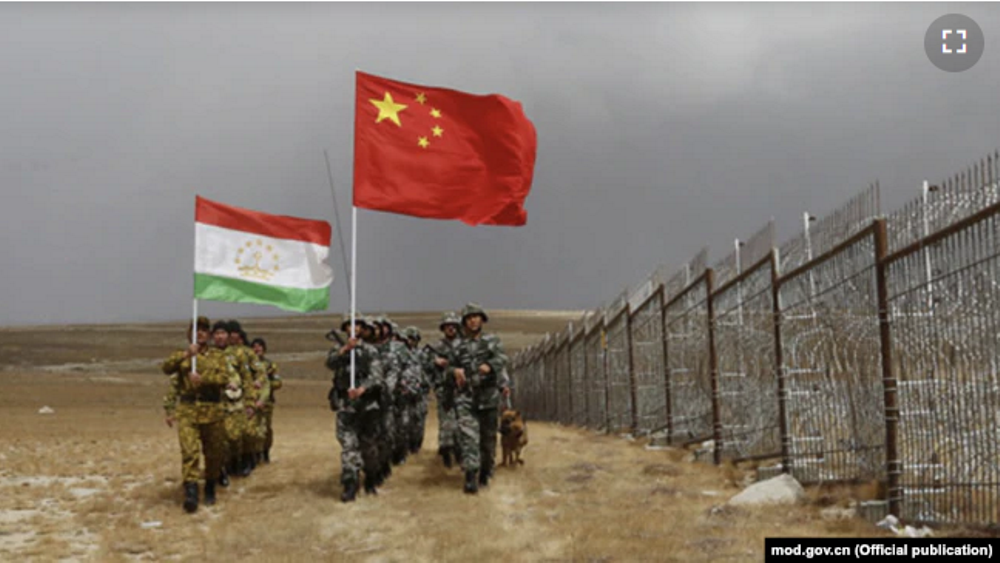
Beijing has moved to expand its security cooperation with the region in recent years, with Tajikistan becoming a focal point. China has long-standing concerns over terrorism spreading in the region from Afghanistan, Pakistan, and Tajikistan that all border its western Xinjiang Province.
Although Tajikistan officially denies its existence, Chinese security forces operate a security base along the Tajik-Afghan border with their Tajik counterparts. Beijing is also renovating old Soviet border outposts and building new border checks along Tajikistan's lengthy Afghan border.
In October 2021, Dushanbe also announced that China would fund and construct new facilities for a Tajik special rapid response unit in the Gorno-Badakhshan Autonomous Region (GBAO)
Tajikistan last month agreed to carry out regular anti-terrorism drills with Chinese security forces on its territory.
After all, Tajik and Chinese personnel have conducted bilateral military exercises in the past, including three since 2015.
But the deal agreed in late November formalizes the growing military cooperation between the two countries and provides a glimpse into Beijing's evolving ambitions for Tajikistan and its Central Asian neighbors.
According to the November agreement, Chinese and Tajik forces will hold drills every two years to improve coordination and the tactical skills of their antiterrorism units. The published text of the deal also states that the timing, location, and scale of the exercises are to be kept secret.
"Unlike Russia, China's drills tend to be smaller-scale, involving internal security services acting in scenarios such as raiding terrorist encampments in the mountains or countering Islamists attacking towns in Xinjiang," Bradley Jardine, a fellow at the Wilson Center's Kissinger Institute on China and the United States, told RFE/RL. According to him, this shows how domestically oriented China's regional foreign policy remains.