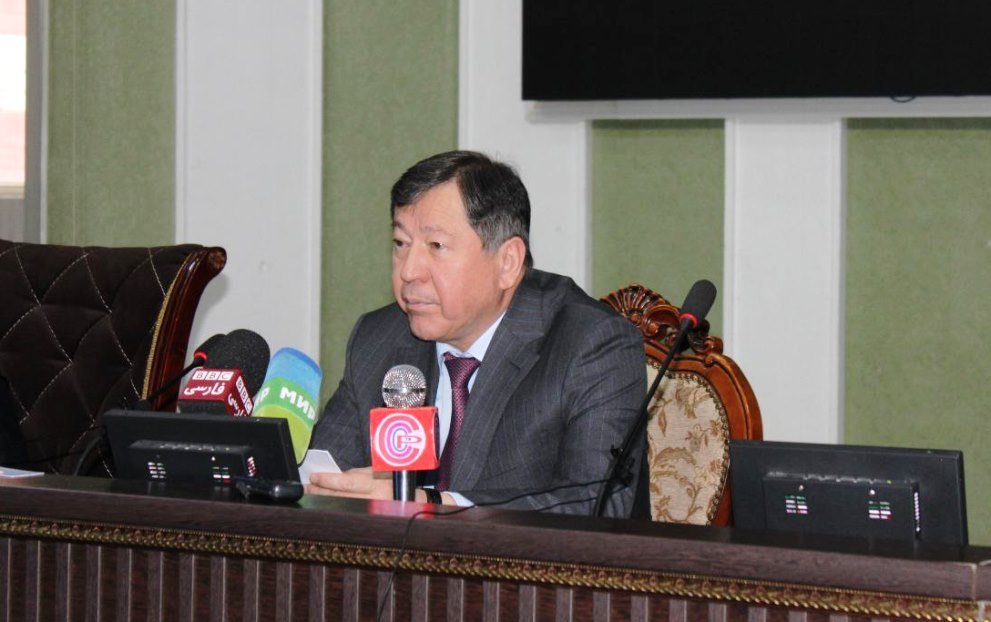
Answering the question about a statement by a Russian top general that “extremist groups” had gained a “foothold” in Afghanistan, becoming “the biggest threat” to stability in the region, Tajik Interior Minister Ramazon Rahimzoda told reporters in Dushanbe yesterday that Tajikistan is ready to repel any threat.
According to him, the country’s power-wielding structures have a plan of actions to ensure security at the border in the event of a threat.
“One of the important tasks of the Interior Ministry, the State Committee for National Security, the Border Troops and other relevant bodies is to provide security at the border. We are always ready, we have a joint plan of actions in such situations,” the minister said.
He further added that “if necessary, the CSTO forces will also be used to support.”
The chief of the Joint Staff of the Collective Security Treaty Organization (CSTO), Colonel-General Anatoly Sidorov, speaking at a press conference on February 14, described al-Qaida and the Afghan branch of Islamic State, known as Islamic State – Khorasan Province, or IS-K, as “the most dangerous” groups.
"The number of members of the Islamic State’s Afghan branch, Wilayat Khorasan (IS-K), has significantly increased to about 6,500, with up to 4,000 militants concentrated in the [Afghan] provinces of Badakhshan, Kunduz, and Takhar along the border with Tajikistan," Russian state-run TASS news agency quoted Sidorov as saying.
According to Sidorov, the biggest threat to stability in Central Asia comes from numerous extremist groups that have gained a foothold in Afghanistan. The Islamic State and Al-Qaeda (both outlawed in Russia) are the most dangerous ones, he added.
"Besides, the policy of oppressing ethnic and religious minorities adopted by the Taliban leadership, as well as the lack of unity and growing discord among the Taliban movement, the deteriorating economic situation and the mounting humanitarian problems, contribute to the destabilization of the situation in the region," Sidorov noted.
He also stressed that uncontrolled drug trafficking and illegal arms trade, in conjunction with the above-mentioned factors, increased the risk of Afghanistan plunging back into civil war.
Meanwhile, the Voice of America (VOA) reported on February 15 that Taliban have rejected as baseless Russia’s allegations that thousands of Islamic State militants have gathered in northern Afghanistan and threaten the stability of the Central Asian region.
“How come thousands of such people are concentrated in one place and still no one can see them or is aware of them?” Taliban Foreign Minister Amir Khan Muttaqi reportedly asked Wednesday in a televised speech at a ceremony in Kabul marking the 34th anniversary of the Soviet troop withdrawal from the country.
“Everyone is welcome here, see the situation with their own eyes and discuss with us if they have any concerns to share. But leveling baseless allegations to malign and add to the sufferings of this nation reeling from decades of war must come to an end,” Muttaqi said, according to VOA.
IS-K is active in South Asia and Central Asia. IS-K has been active in Afghanistan and its area of operations includes Pakistan, Tajikistan and India where they claimed attacks, as well as Sri Lanka, the Maldives, Bangladesh and China where individuals have pledged allegiance to it. The IS-K and Taliban consider each other enemies.
The group was created in January 2015 by disaffected Taliban in eastern Afghanistan, although its membership includes individuals from various countries notably Pakistan, Bangladesh, India and Myanmar. Its initial leaders, Hafiz Saeed Khan and Abdul Rauf Aliza, were killed by US forces in July 2016 and February 2015, respectively. Subsequent leaders have also been killed; its leader Abdullah Orokzai was captured in April 2020 by Afghanistan's intelligence service.