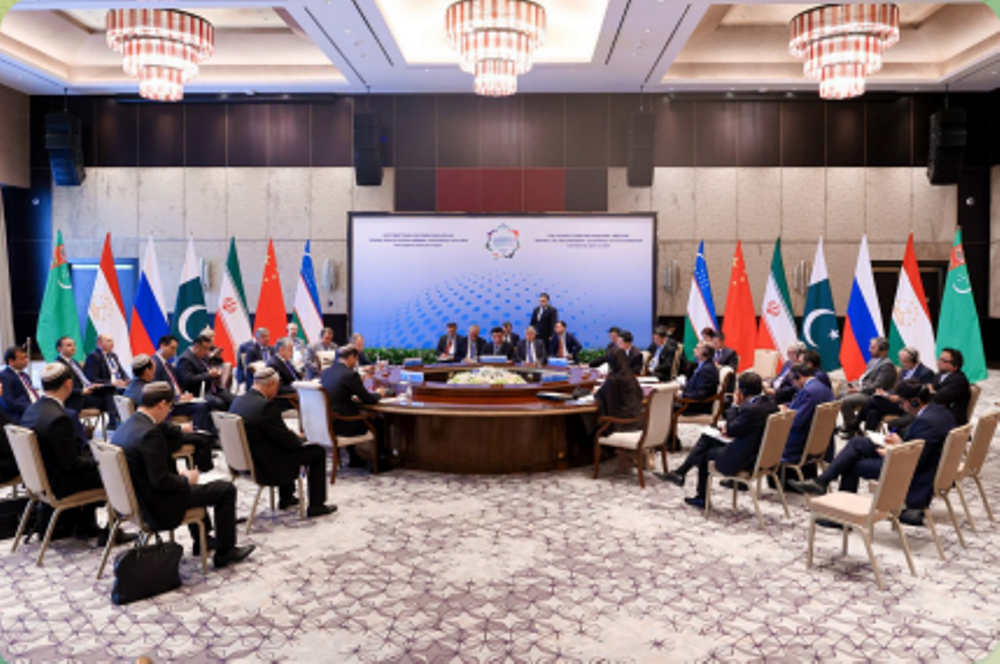
The Fourth Meeting of Foreign Ministers of Afghanistan’s Neighboring Countries that took place in Samarkand yesterday resulted in adoption of the Samarkand Declaration.
The parties, in particular, reaffirmed the commitment to the development of Afghanistan as a peaceful, united, sovereign and independent state, free from the threats of terrorism and drug trafficking.
They noted the importance of building an inclusive and broad-based governance system in Afghanistan that reflects the interests of all segments of Afghan society.
The parties noted that the terrorism-related security situation in Afghanistan was still severe and reaffirmed their commitment to enhance cooperation on counter-terrorism and security among neighboring countries and to develop a united front against terrorism.
They pointed out that all terrorist groups, namely the Islamic State of Iraq and the Levant (ISIL), Al-Qaeda, the Eastern Turkistan Islamic Movement (ETIM), the Tehreek-e-Taliban Pakistan (TTP), the Balochistan Liberation Army (BLA), Jundallah, Jaish al-Adl, Jamaat Ansarullah, the Islamic Movement of Uzbekistan (IMU), and other terrorist organizations based in Afghanistan continue to pose a serious threat to regional and global security.
The parties stressed the importance of combating the drug threat and called for support for the development of drug crop substitution programs, as well as for combating drug production and trafficking.
The parties emphasized the necessity for the international community to maintain dialogue and communication with Afghanistan and called for further measures to improve the living conditions of the people and expressed confidence that the Afghan authorities will respect fundamental human rights, including the rights of all ethnic groups, women and children, and will provide every citizen of Afghanistan with equal rights to participate in the socio-political, economic and cultural life of the country.
The parties noted the relevance of coordinating regional and international efforts to ensure security and stability in the region, emphasizing the positive contribution of existing regional forums, including the Tashkent International Conference "Afghanistan: Security and Economic Development" and the Moscow Format Consultations on Afghanistan.
The parties noted the key role of the United Nations in providing humanitarian assistance to Afghanistan, calling on the international community to intensify emergency humanitarian assistance to the people of Afghanistan.
They reaffirmed the importance of countering attempts to politicize the provision of humanitarian assistance needed by the people of Afghanistan and stressed that the distribution and use of humanitarian assistance should serve for the benefit of the ordinary Afghan people.