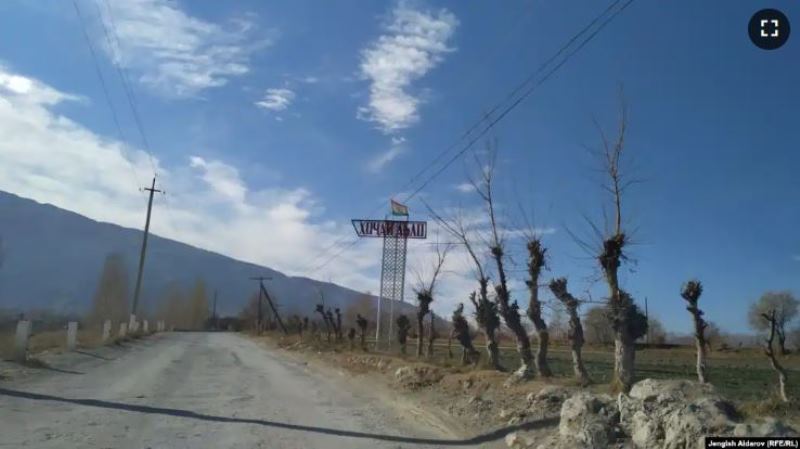
Authorities in Kyrgyzstan’s southern region of Batken say the border with Tajikistan, shut down more than two years ago following a deadly standoff, can "gradually reopen" after delimitation and demarcation work between the two nations is fully accomplished.
Radio Liberty’s Tajik Service reported on August 4 that the Batken regional administration said on August 3 that border issues had been discussed last month by officials of Kyrgyzstan, Tajikistan, and Uzbekistan, adding that the issues of security and safety in areas close to the three nations' borders were the main focus.
The statement came hours after Rajabboi Ahmadzoda, the governor of Tajikistan's Sughd province bordering Batken, said he and his Batken counterpart, Abdikarim Alimbaev, had reached an agreement at talks last month in the Kyrgyz resort town of Cholpon-Ata to reopen the Tajik-Kyrgyz border for residents of the areas close to the border and vendors.
Kyrgyzstan closed the border in spring 2021 after an armed conflict along a disputed segment of the border left 36 Kyrgyz nationals, including two children, dead and 154 injured on the Kyrgyz side of the border.
Tajik authorities officially said at the time that 19 Tajik citizens were killed and 87 injured at the time.
Tajikistan and Kyrgyzstan have not yet resolved the border delineation problem. Many border areas in Central Asia have been disputed since the collapse of the Soviet Union in 1991. The situation is particularly complicated near the numerous exclaves in the Ferghana Valley, where the borders of Tajikistan, Uzbekistan, and Kyrgyzstan meet.
The border of Kyrgyzstan and Tajikistan has been the scene of unrest repeatedly since the collapse of the former Soviet Union. Border talks between Tajikistan and Kyrgyzstan began in 2002. The countries share 972 kilometers of border – of which only 664 kilometers have been properly delineated, leading to tensions for the past 30 years.
To-date, Tajikistan and Kyrgyzstan have reportedly held more than 170 meetings and negotiations on delimitation and demarcation of the common border.
In all, the border between Kyrgyzstan and Tajikistan is 972 kilometers, of which 664 kilometers have been agreed upon, while the rest remain disputed.
Tajikistan and Kyrgyzstan renewed interest in border delimitation suggests that the governments want to dedicate more attention and resources to the communities living in the Ferghana Valley.
Recall, media reports said in late July that Kyrgyzstan President Sadyr Japarov is expected to pay visit to Tajikistan from September 14-15 this year.
According to data from Tajikistan’s Foreign Ministry, the 5th consultative meeting of the heads of Central Asia’s nations will take place in Tajikistan’s capital, Dushanbe, these days.
Besides, the next meeting of the Council of Heads of Founding States of International Fund for Saving the Aral Sea (IFAS) will be held in Dushanbe on the same days.
Some sources say leaders of Tajikistan and Kyrgyzstan will possibly carry out bilateral negotiations to discuss issues related to state and prospects of further expansion of cooperation, including border delineation problems.